
Reveille
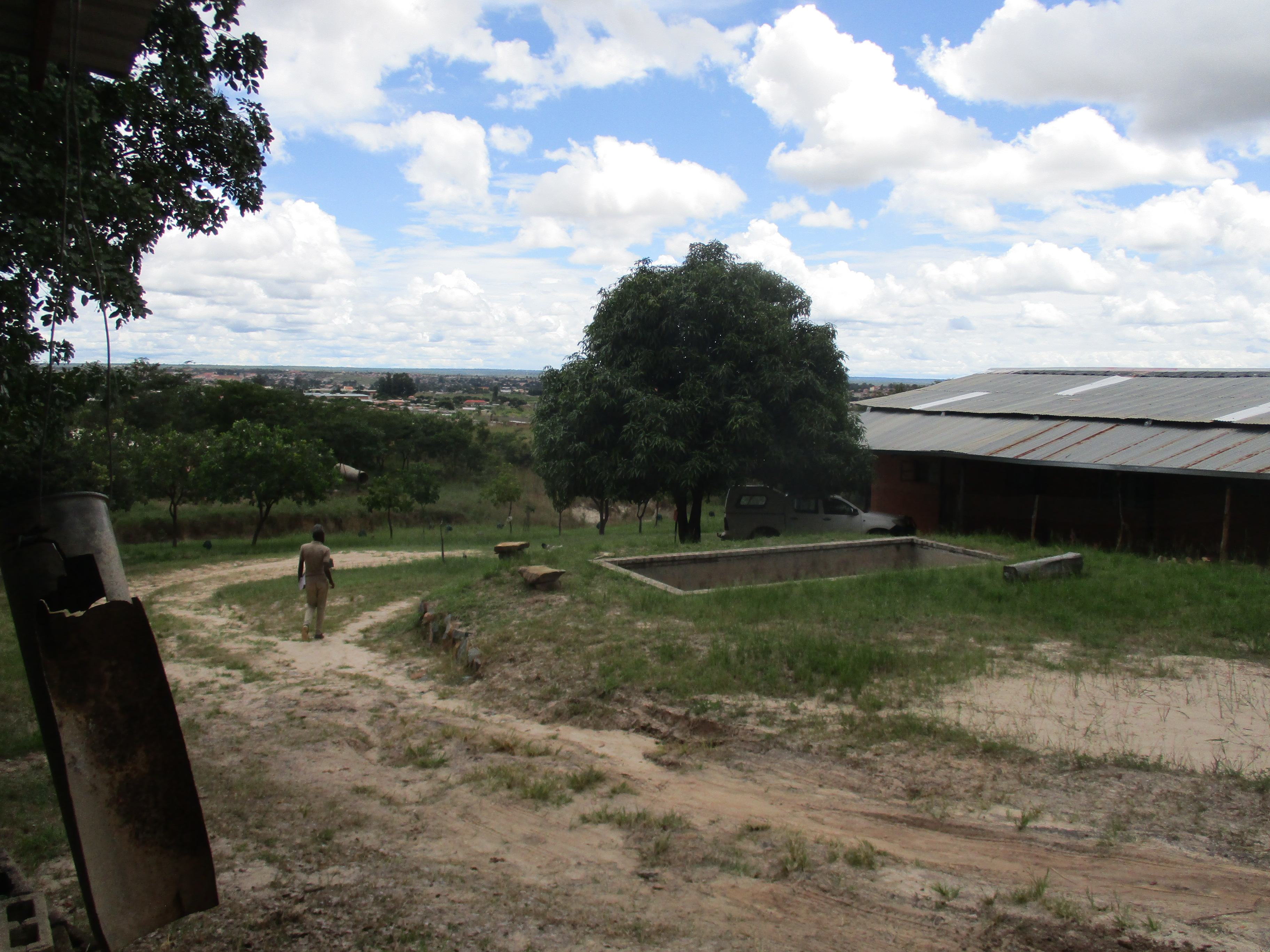
On my first Monday in Menongue, I was awakened by the OM version of “reveille” – not as melodic as the morning bugle that I remembered from my youthful days at boys’ camp, but much more compelling. The alarm consisted of a metal cylinder torn open along its length and hung from an eave of the mission school building. Every weekday morning, one of the mission students hammered on this apparatus for about a minute. This unromantic din floated unhindered across the yard to my open window, forcing me to greet the day.
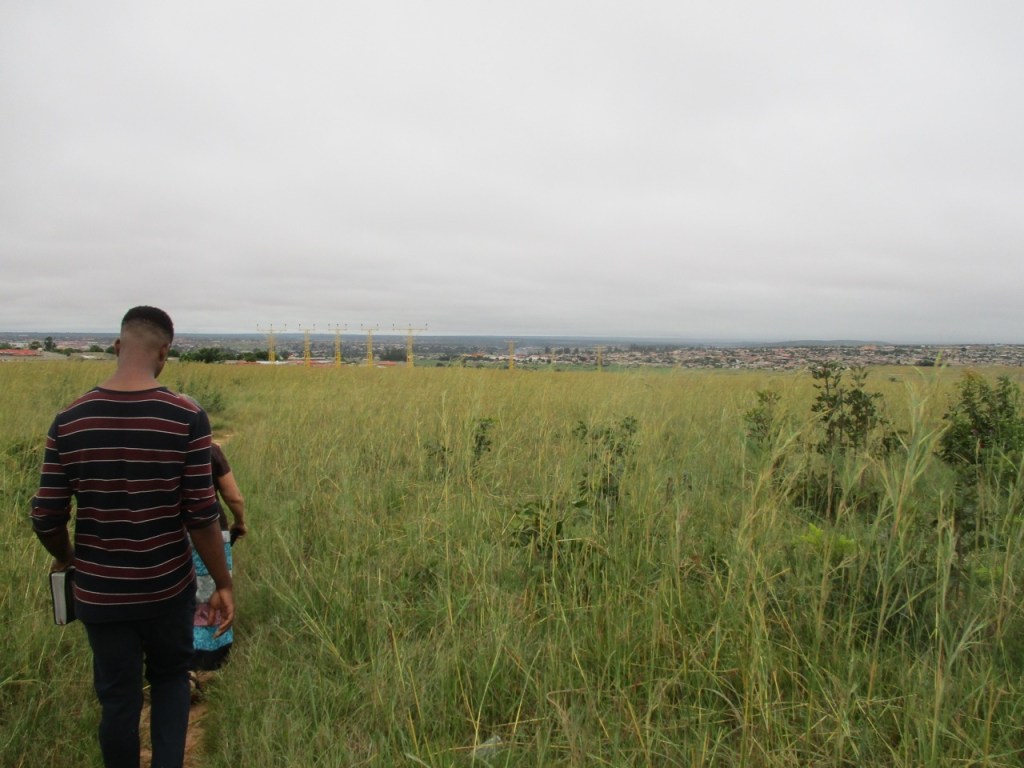
Effectively awakened in this manner, I was up by 6 and joined Joan and Herivaldo for a walk to a cluster of homes in a nearby neighborhood. We were heading for a discipleship meeting. The morning dew had not yet burned off as we walked a narrow trail through the tall grass. The temperature dropped down into the 50s (F) at night before getting back into the 80s by midday. We made our way to a small house about 8 by 10 feet in size. There were nine children in attendance, so the structure was crowded. Some sat on the floor, some on chairs, and some on the older kids’ laps. This was a new discipleship group. Herivaldo taught from a lesson titled “One God, One Way.” When beginning with a new group, they teach the basics from the Bible: Jesus is one of the three persons of the Trinity – the Father, the Son, and the Holy Spirit. The three exist as one God, all powerful, with love and mercy for mankind. Existing before all things, God created all things. Separated from God by sin, mankind has only one hope, Jesus – the One Way back to God.
After the discipleship meeting, I made it back to the base in time to catch the end of Delfina’s lesson to the students on the book of Job. She had an energetic instruction style. She talked about how we can receive bad even while obeying God, but that we can praise the Lord even in suffering.
Breakfast was at 8 am, and it consisted of cornmeal cereal with bread and butter. While we ate, a man from the neighborhood came with a broken laptop, and I was asked to take a look at it. A PC hobbyist in my youth, I hadn’t tried my hand at fixing a computer in several years. I asked for a set of small screwdrivers and then set about opening the case. There is an American doctor in Angola in remote Cavango named Tim Kubacki. Every morning at at his mission hospital, Dr. Kubacki tells the gathered patients that it is the Lord who heals, though we are His instruments. I was certainly ready to give Him the credit for any good that came of my meddling with that laptop.
The laptop’s owner said the screen wasn’t working most of the time, though it would blink on every now and then. Carefully opening the case, I followed the wires from the screen down to where they plugged into the motherboard. The wires seemed to be catching on the hinge, so I carefully tucked them out of the way and checked that they were solidly connected. That’s when I noticed that the laptop had a few bugs. They were crawling around under the boards. They would not come into the light, and I didn’t have a vacuum to properly “debug” the laptop. I reluctantly put everything back in order and closed the case. I pressed the power button. The laptop booted up, and the screen stayed on. Breathing a prayer of thanks and resolving to have proper tools with me in the future, I handed the laptop back to its owner.
Academic school
At mid-morning, I went across the gully to attend one of the classes at the academic school for the local children. When I arrived, Elisa was teaching while Joan observed. After a few minutes, Joan introduced me to the class and told them I might bring my wife and quatro crianças (four children) to live there. “Would that be a good thing?” she asked them in Portuguese. There was an enthusiastic reply of sim, sim (yes, yes). The students were bright, attentive, and well behaved.
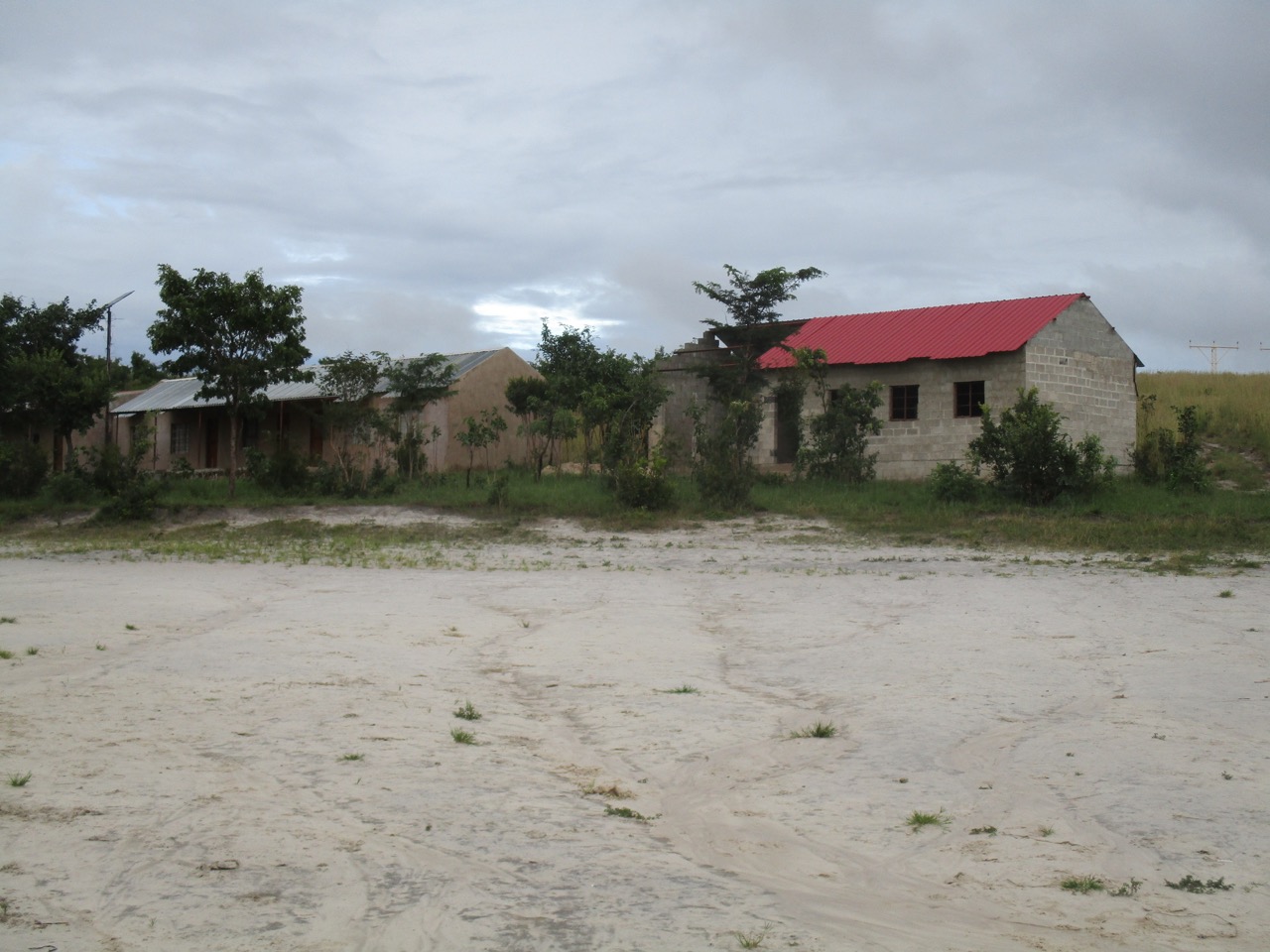
Joan told me that they started building the academic school about a decade ago, and their efforts had really come to fruition in the last few years. They allowed a maximum of 30 students per grade, which was the government’s minimum requirement. The Angolan government provided the books and was soon to provide teachers, and Joan and Elisa were allowed to work Bible lessons into the curriculum. As I left, a couple of boys were playing soccer on the field in front of the school, and I kicked the ball around with them for a while.
Discipleship lesson at the church
The church we visited on Sunday had invited Wessel to return for a special discipleship class. So, we returned to the church at 5 pm to give a short lesson. There was a good turnout with about 20 people in attendance. Wessel went to the front to start the class, and I sat down on the end of an empty wooden bench. Wessel had told me to contribute any thoughts I had during his message, so I mentally brushed up on the little lesson from Psalm 1 that I had prepared for Sunday. Deep in thought, I felt a sinking sensation. The simple benches stuck out at both ends, so as I shifted my weight at one end, the other end raised up. I shifted toward the center, and the bench came banging down on the hard floor. With a smile and a little shrug, I waved a sheepish apology.
After a few minutes, Wessel called on me to give the lesson I had prepared. He translated as I spoke. The text was Psalm 1:1 about not walking in the advice of ungodly people, standing with sinners, or sitting down to commune with those who are hostile to the gospel. The passage represents a progression of downward living when we are not careful in our Christian life, to the point that we are actively scornful of the Bible and its precepts.
My talking points seemed to resonate with Wessel, and he went into a rousing exhortation after each sentence or two that I spoke. His style was effusive, having the listeners repeat words and touching their shoulders and maintaining eye contact. He had their undivided attention. He continued with the lesson to talk about laying down every weight to run the race set before us. He then encouraged them to be as trees planted by the living water. I noticed that he rarely wrote or said “God,” but preferred “Father” when speaking, and wrote “JHWH” on the board to represent Him.
Dinnertime sharing
At the dinner table that evening at the base, I shared pictures of my family and me. I had brought many photos, but I winnowed them down to three subjects. I showed them pictures of our various camping and hunting trips. And I showed them the dedication service for one of my sons when he was a few months old. Lastly, I showed them pictures of our trip up Pikes Peak in Colorado on the cog railway when our first two children were little.
The food that evening was described to me as a traditional Angolan meal. It was grilled fish accompanied by a cassava lump they called funge or fuba de bombo, served with a red sauce and cassava leaves. I was told it is to be eaten with one’s fingers, so I joined in eagerly and enjoyed the delicious meal. It became my favorite dish, and we had it several times.
Comparing notes
After the meal, Wessel and I talked into the night. He asked about my calling to Menongue, and he talked about his military service, calling, and work. I told him about how I had looked at a map of the world, and Angola stood out from the other nations. I related to him how I had cut the list of cities down to Menongue and all the research I had done before I had contacted him. We found some similarities in our stories.
Wessel and Joan were married when he was 32 (I got married at 31). He was already in missions at that time, serving as a pastor to farmers for several years. When he found that they were unwilling to take time off for Sunday service, he asked if they could set aside a half hour each week to meet with him one-on-one. Wessel had served in the South African military when he was younger, and he had fought in the Angolan civil war, serving the interests of South Africa in fighting the influence of communism. He had attained the rank of corporal when he was discharged. The military tried to call him back, but he decided he’d had enough of fighting. Later in his life, he too, would look at a map of the world and decide to go to Angola, this time with his family to heal and not to fight.
Roadside assistance
Something quite strange happened that day. Wessel found an Angolan woman bound at the side of the road near the mission base. He picked her up and loosed her bonds. She seemed mentally unhinged, answering questions only haltingly. He got little information other than where she lived, so he took her home to the surrounding neighborhood. There was speculation that she might be possessed and that her husband had bound and abandoned her. Pastor John was summoned from Cuito Cuanavale to help with the situation, since he had experience with such spiritual battles. He would try to come soon.
From different sources, I had been hearing rumblings of the coronavirus and its effect on the world. South Africa and parts of Europe were being hit hard. One by one, nations were closing themselves off from the rest of the world. One line from my journal entry that night summed up the concerns of the day.

 Welcome to Angola