
A night of fitful slumber
Sleep eluded me some nights more than others. This was one of two nights in Angola when I awoke with irrational fears clutching at my heart. My home is far distant; I might get sick; I don’t know what I’m doing; death is just a breath or heartbeat away; I might never see my family again. Thoughts that could not bother me in the light of day had free rein in the darkness. Nightfall fosters fearfulness. I awoke about 3 am and lay there struggling with these and other specters. I focussed on praying and writing in my journal, finally falling back to fitful slumber around 7. I got up late that morning and struggled with fatigue most of the day.
Morning Bible lesson
I found Wessel on the front porch giving a Bible lesson to two boys who had come from the church we attended Sunday. He drew on a dry-erase board while he talked. His lesson was simple and to the point, and he made good use of illustrations. He taught that humanity is separated from God by sin. To make a path of reconciliation, the Father sent the Son to die in our place for our sins, paying a debt that we could never pay. To be reconciled to God, we must now repent of our sins, leave sinning behind, and cling to God instead of the world. To illustrate the concept, Wessel drew a man separated from JHWH (Yahweh, God) by a wide chasm. To span this gap, God placed the cross of Calvary. But the man is carrying a burden of sin and cannot pass over while carrying it. He must set aside the burden – repent and sin no more – so he can avail himself of the sacrifice and make it back to God.
Academic school lesson
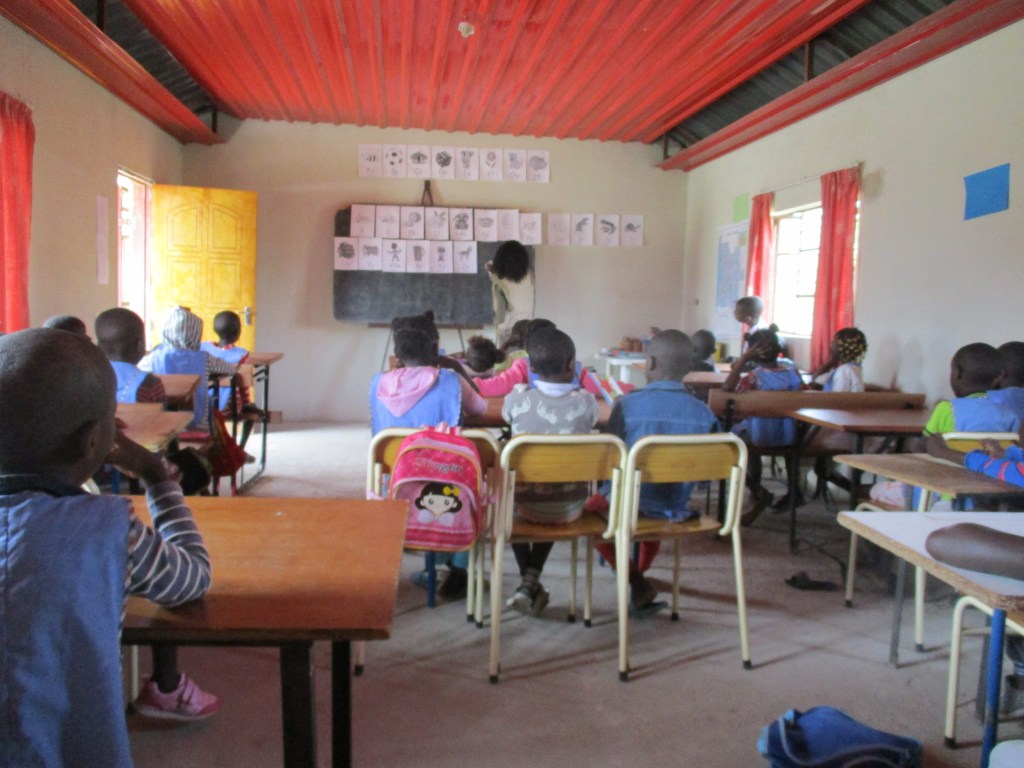
I walked across the chassis-and-concrete bridge to the south side of the base, and I sat at the back of Elisa’s class while a light rain pelted the metal roof. It had been raining sporadically all day. Despite that fact, almost all of the children were in attendance at the academic school. At other government schools, the students are quick to skip a day because of rain, but such is not the case at El Shammah school. They want to be there.
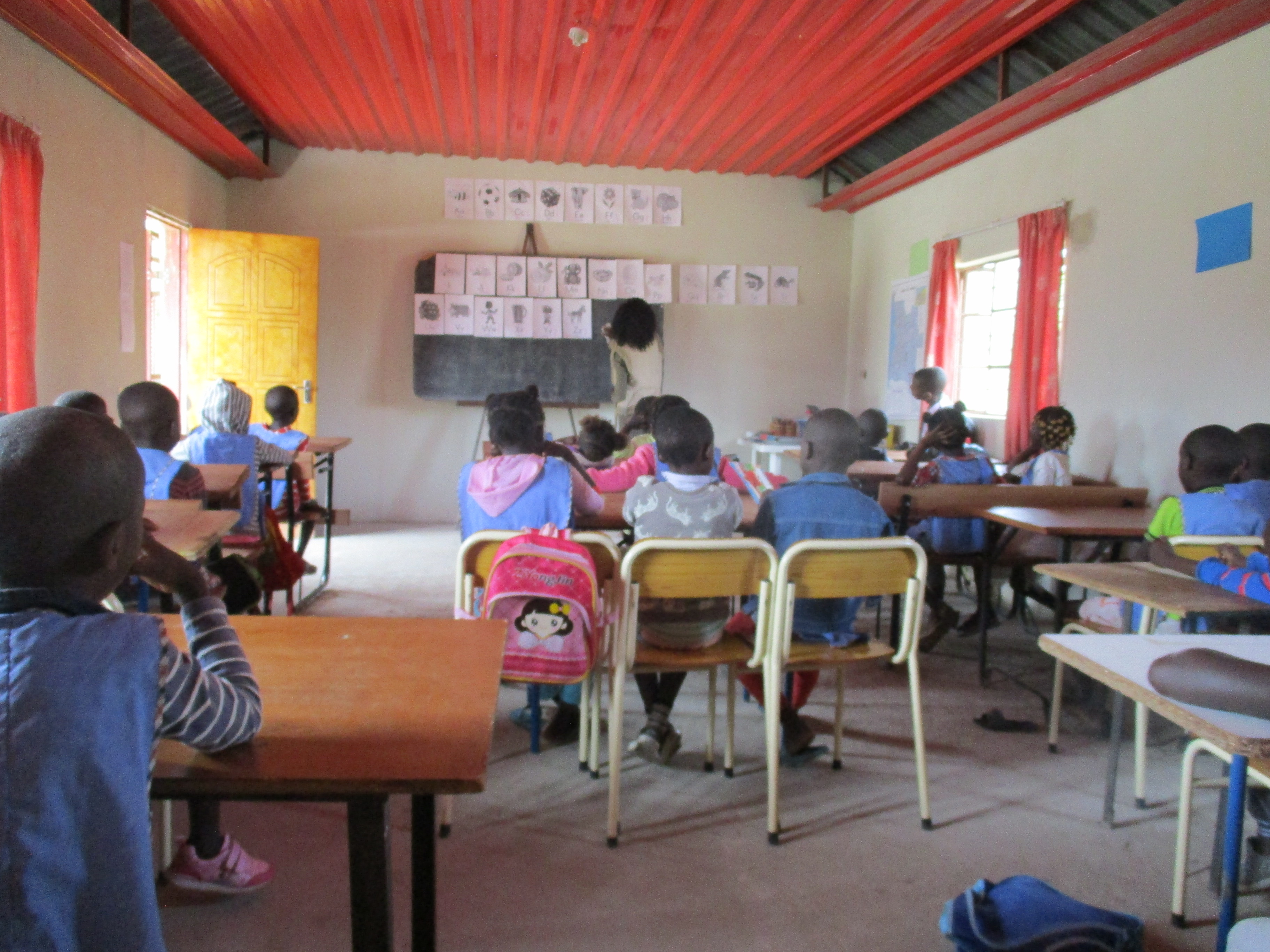
Aside from a few curious glances in my direction, the children did a good job paying attention and participating. They were reviewing the letters of the Portuguese alphabet, which look the same and are in the same order as the English alphabet but have different names and sounds. All the instruction at the school in is Portuguese, but I could distinguish the important words that Elisa spoke. There are dois grupos (two groups) of letters – consoantes e vogais (consonants and vowels). The students sang a song for each letter and a word that goes with it, like agá (H) is hipopóta (hippopotamus) and O is ovo (egg). After the review, each child said their name and the letter it started with and whether it was a consonant or vowel. When the students answered correctly, they would hear muito bem! (very good!) from their teacher. When class was dismissed, all the students came to the back to greet me, and they were all smiles and fist bumps.
Elisa’s story
After we left the classroom, Joan was there with us, and she related some of Elisa’s remarkable story. She had received little formal education. She sold charcoal to help pay for her siblings to go to school. Yearning to read and write, she prayed to God to grant her those abilities. When she was about 16 years old, she found that she could understand some of what was on a page of text, and her skills quickly improved. Later in life, Elisa came to the OM base in Menongue as a mission student. After graduation, she started teaching at the school. She had become the main Angolan instructor, creating curriculum and directing the teaching approach, and she trained others to teach effectively. Elisa wrote many of the songs they use in class, and she even dealt with government officials regarding the academic school.
Joan stopped at the bridge over the gully and talked to me about Carmen and our children’s education. She said that as Carmen is educating the children, she doesn’t need to feel that she must do it all in our house or all by herself. She could send them to play with the other children or attend a particular class. Joan had home schooled her own children, so she understood many of the challenges that were ahead of us. She also said there were many ways that Carmen could contribute to the ministry when she was ready, specifically mentioning the women’s prison visits and a needlework trauma ministry.
Pastor John arrives
When I was done talking to Joan, Pastor John from Cuito Cuanavale was waiting at the other end of the bridge. The three of us discussed the woman that Wessel had found on the road the day before. Joan thought she was perhaps mad or possessed and that her husband had possibly been the cause of it. John listened and said that he would visit the woman later that day. He remarked that the woman was not necessarily possessed and that there were many explanations for such erratic behavior. I asked him how many times he had encountered someone he thought was possessed. This is one of his gifts, one of his ministries, they say. He said he has dealt with many people who were mentally disturbed, and a few that he thought were truly possessed. John invited me to visit his city before I leave Angola. There was still much evidence of the battle of Cuito Cuanavale in the countryside around the city. Rusted out tanks still lined the roads, downed helicopters still dotted the fields, and many confirmed minefields still guarded the city. A giant panoramic monument was erected years ago in Cuito Cuanavale to commemorate the battle.
English lesson
The rain fell harder as the day progressed. The rains would soon taper off as the seasons changed. The agriculture class was cancelled because of the rain, so I went to Ericleidy’s English class for the mission students. They were doing the letters of the alphabet, just like the kids were, except these students were learning the English alphabet. They were singing a variation of the English alphabet song that I had never heard before, and since they teach British instead of American English, the last letter was “zed” instead of “zee.” The students spelled their names with English letters, and Ericleidy had me spell my name. At the end, the students asked me questions about my hobbies, name, birthday, and age. I, in turn, asked Ericleidy some questions about Portuguese.
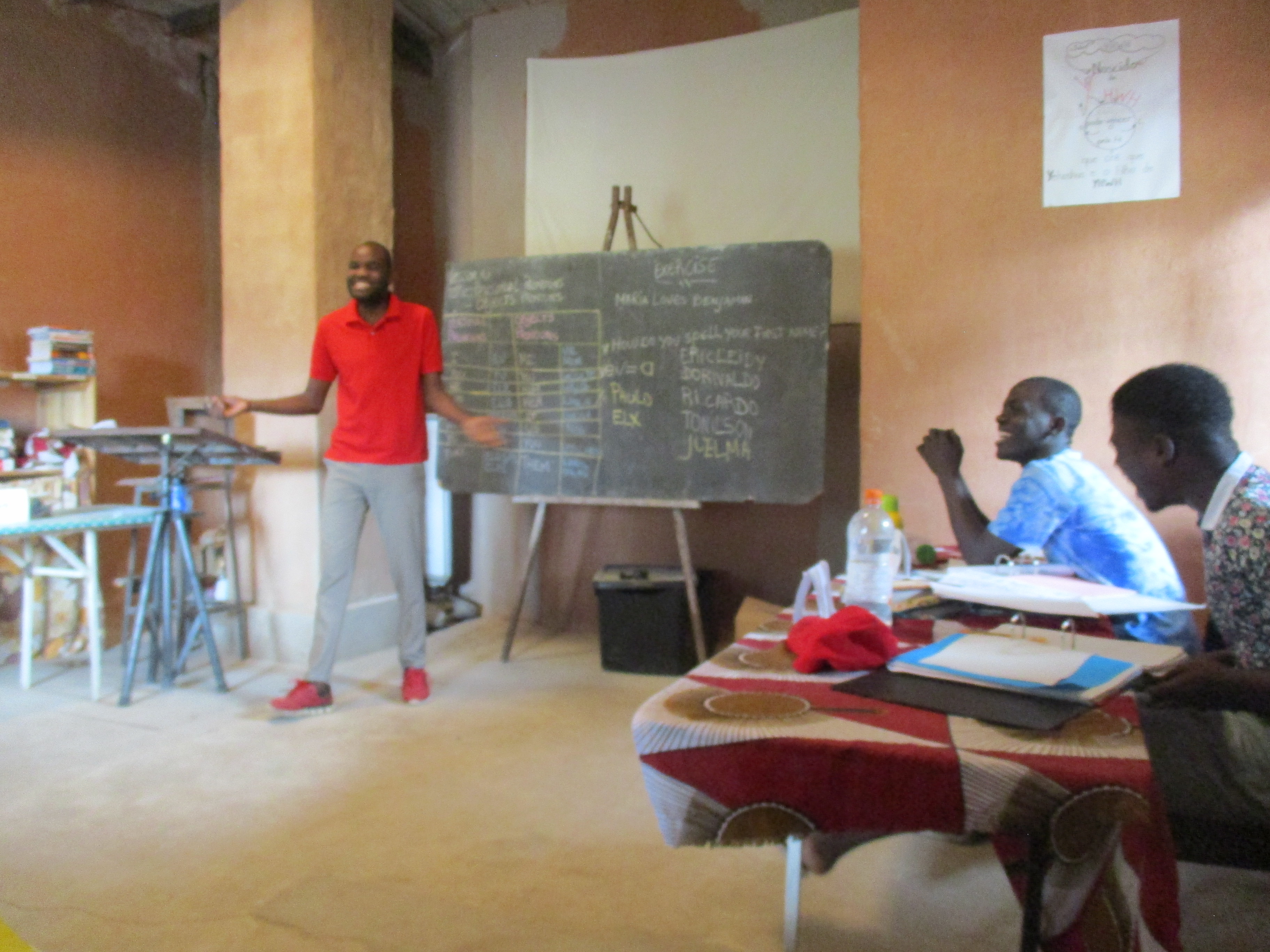
After class, Ericleidy said it would be his privilege to teach Portuguese to me and my family. On the way back to the house, he told me he left everything in Luanda about a year ago to come to rural Menongue to work at the OM base. He left family, friends, and university to come to work at this rural location for the glory of God.
Visiting the “mad” woman
That evening, I went with John and Delfina to visit the “mad” woman, not knowing what to expect. Joan also walked with us at first, then she split off to go see a different woman who had recently been bitten by a snake. This type of snake lurks down by the riverbanks, waiting for its victim to come to the water’s edge. It injects a venom that, though not usually fatal, attacks the nerves and destroys the flesh around the bite. The resulting infection can be deadly if left untreated. Joan was going to see how well the woman was healing and to dress the wound.
It was lightly raining as John, Delfina, and I approached a simple home. A small stream ran down the narrow pathway between the cluster of houses. The entrance had no door, just a curtain to suggest to the weather that it should stay outside. The single room was weakly lit by a hole in the wall that served as the structure’s only window. The inside was cramped, with the woman sitting on one side and her three unexpected visitors standing across from her. Our hostess was calm and seemed ordinary, except for an injured knee. The dirt floor crunched softly under our feet as a multitude of flies circled the room, alighting on us, the woman, her wound.
After introducing ourselves, John and Delfina started the visit like a worship service, with singing and prayer, before talking to the woman about her circumstances. I was largely in the dark about the conversation, though John did translate some of it for me. Her husband had quit the church for a vague financial reason, and this had distressed her. Alcohol had a role to play, and things escalated to the point that the husband tied her up and left her on the roadside near the OM base. After Wessel found her and restored her back to her home, her son took her to a witch doctor, who gave her a toxic substance with instructions to drink it and then vomit it back up, as if that would somehow solve the deep interpersonal conflict in her family. She didn’t bring the concoction back up fast enough, and it damaged her lip and internal organs. We sang praises and prayed some more.
Though most Angolans identify as Christian, religious pluralism, animism, and ignorance of the Bible are still widespread. Christianity is often a nominal claim (having a form of godliness but denying the power thereof). Many missionaries long ago had the singular focus of getting a “confession of faith” with little follow-up with new converts to help them understand that their new faith should govern the way they behave and believe. (On the other end of the spectrum, a mission worker might erroneously think that new converts must abandon all aspects of their culture in favor of Western culture. Discernment and balance are essential.) In the absence of spiritual guidance, the tendency was to incorporate their new Christian identity with their old beliefs and practices (syncretism). When fear and uncertainty crowd in, instead of turning to their Creator, they revert to their old “solutions.”
Evidence-based medicine (the idea that illnesses can be identified and effectively treated by analyzing symptoms and administering tests) is not widely practiced in Angola. In this knowledge vacuum, the witch doctor still holds much prestige, though his “treatments” are crude, dangerous, and often deadly. The shaman’s prescribed “cures” often kill people who would otherwise have recovered without intervention. And where evidence-based medicine is introduced, there is the danger of not acknowledging the Great Physician as the power behind the medicine. In that case, the medicine tends to get rolled into the existing animistic belief system, and no real transformation takes place in people’s lives.
The woman’s son soon arrived. He was young and dressed in nice jeans and Nike shoes like any random teen in America. He looked out of place in this meager home; I was still getting used to seeing old and new so starkly juxtaposed. With his dress and demeanor, he was identifying with the modern world, but his mind still turned to the ancient ways in time of trouble. John compelled him not to take his mother to the witch doctor anymore; that he should take her to a medical doctor or to the OM base where someone could treat and pray for her.
The thoughts in my journal were raw. Since that day, I have often wondered how the experience looked from her perspective. Did she appreciate our presence and purpose, or was she frustrated at the intrusion? Was she glad for the worried attention, or was she embarrassed that her personal affairs were on display? We were following the pattern that Jesus established of meeting the physical, mental, and spiritual needs of the people around us. Our interest in her well-being was genuine, but was that effectively demonstrated? Jesus didn’t just lecture the needy people He encountered. He sat with them, communed with them, understood their pain. How can we best mirror His example?
Evening discussion
That evening after the meal, Herivaldo and me were left alone in the dining room. I shared the day’s events with him, adding that I didn’t know how I would get home if coronavirus shut everything down, but I was trusting God. Between his English and a translation app on his phone, he told me about his 6 brothers and 1 sister whom he had not seen in over a year. He was missing his family terribly, especially his mother, who meant everything to him. We talked about how absence from loved ones impacts us. We agreed that being apart from our families can build our patience and trust in God.
I went to my room and lay down on the bed. There was a small leak in the ceiling. As it continued to rain outside, there was a steady pit-pat on the floor as the drops fell just a few inches from my head. I put a bucket under the leak, and then there was a steady plip-plop instead.
Decision time
It was Tuesday the 17th, and my flight home was scheduled for Friday the 20th. There were unconfirmed reports that the Angolan borders would close by the end of the week for incoming and outgoing flights. In preparation to close international borders, domestic flights were being canceled as well. The OM campus was near the end of the Menongue airport runway. I had been watching the commercial flights arrive and depart throughout the week. Soon there would only be military aircraft coming and going.
Interspersed with the day’s activities, I had been making calls to figure out how I might get home. I tried calling the US embassy in Luanda, but I only had a generic phone number. I could leave a message, or I could make an appointment in Luanda between 2 and 4 in the afternoon, Monday through Thursday. Since getting to Luanda was the whole point, I just left a message and hoped they would respond. I had been on the phone with Carmen as well. She found an unconfirmed flight for Thursday the 19th, but nothing definite. All information I could get was unreliable, and I couldn’t contact anyone with authority.
I had a decision to make: scramble to get to Luanda however I could, or attempt to ride out the storm in Menongue, which likely meant staying at least two more weeks. There was an overnight 20-hour bus ride to Luanda, but the prospect of a long, uncomfortable ride on the mere speculation of getting a flight was very unattractive. My flight to Frankfurt could easily be canceled, and neither OM nor I had the resources for me to stay in Luanda indefinitely. Furthermore, I had just barely arrived and gotten acquainted with my hosts; I disliked the idea of cutting my brief trip even shorter. If I ended my vision trip at that juncture, I didn’t know if I would ever return to Angola. After much prayer and deliberation, I decided that if it came down to it, I would rather be stranded in Menongue than make a desperate dash for Luanda.

 Welcome to Angola