
Putting me to work
When I first sent a letter to Wessel about coming to Angola, I had mentioned that I had some experience as an amateur handyman. So, when I came for a visit, I thought that there might be some work that I could do. It wasn’t until the coronavirus lockdown that I was finally put to work. The academic school buildings were unassuming affairs, and Wessel had long wanted to decorate the interiors to make them more interesting for the students. To that end, he had purchased some heavy-duty red marine paint, and he wanted to test its durability. He had me work with Herivaldo to paint a rectangle of this new paint at the entrance to the schoolrooms. We started by thoroughly sweeping the dust out of the way. We then drew an outline with a pencil and carefully painted in the shape. The paint was noxious but seemed to be high-quality stuff. I was glad to finally be doing something productive, and this would be the first of several useful tasks.
Shopping before lockdown
We had one more trip to make into town to get a few supplies before the lockdown began. We first went to a hardware store. It was small and densely packed with plumbing, electrical parts, wheels, appliances, etc. Wessel haggled over LED rope lighting while I walked up and down the narrow aisles checking out the rest of the store. Wessel later explained that the small stores in Menongue didn’t have a lot of regular stock. Instead, they bought what they could, when they could, and they had to guess what demand there might be for a particular product. In this case, the store didn’t have enough A/C adapters for the lengths of LED rope lighting. Wessel had to buy a large length of lighting to get the last plug for it to operate.
A television at the hardware store played the Arabic-language Al Jazeera channel. After we arrived, it was switched to Al Jazeera English. It gave me a glimpse of international news. The story of the day, of course, was coronavirus, and the latest was from South Africa, which at that point had the highest number of infections among African nations. On that day, South African president Cyril Ramaphosa said in a televised ad, “From midnight on Thursday, March 26 until midnight on Thursday, April 16, all South Africans will have to stay at home.”
The rest of the world seemed to be in turmoil, and I wondered when or if it would reach Menongue. The coronavirus had not yet made inroads into Angola. In time, the coronavirus would make it to the interior of Angola, but at that time, I felt comfortably insulated from the chaos. Indeed, the security lady’s comments at the Frankfurt airport seemed prescient. It did seem safe in Angola – for the moment.
To complete the next building for the academic school, Wessel’s hired workers needed to make more concrete blocks using the mold they had at the base. So, we stopped at a warehouse that sold two kinds of concrete. The bags were sized at 50 kilograms, about 110 pounds, and we bought as many as would fit in the back of the truck.
Outdoor market
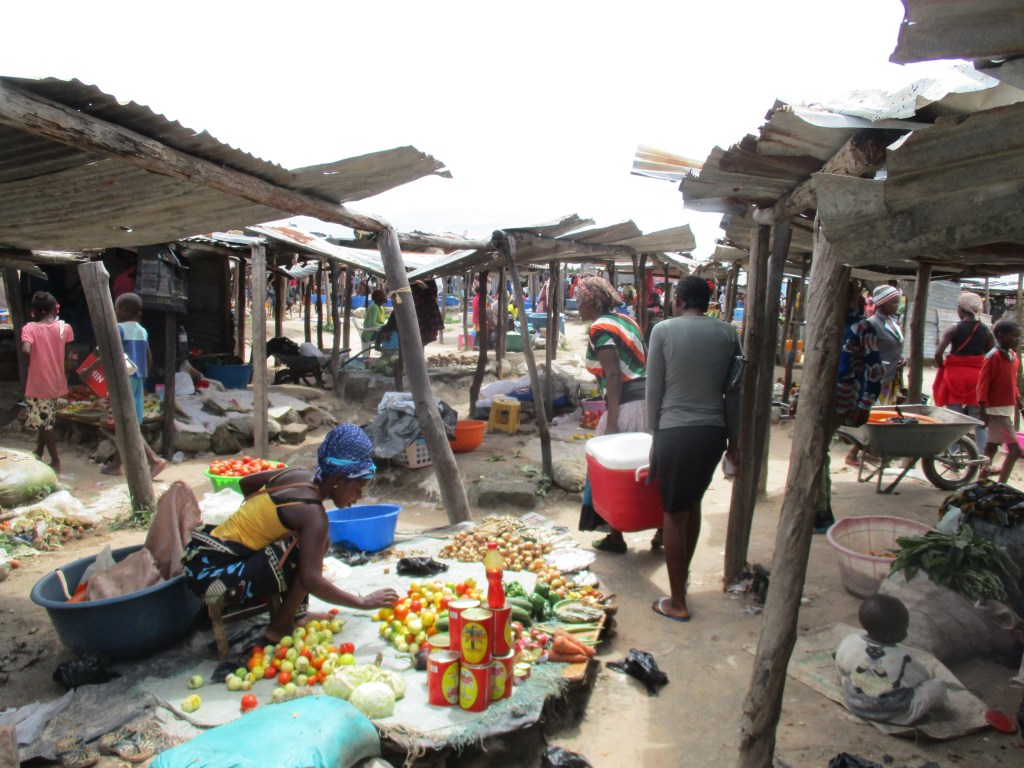
I was excited to learn that we would visit one of the local markets. Few things captured my imagination about foreign lands like an open-air market. In the absence of firsthand knowledge, I imagined that it must be like the great bazaars of the orient, complete with live poultry running around, merchants loudly hawking their wares, and crafty pickpockets working the crowd. The reality wasn’t nearly so exotic, but it was different from anything I’d ever seen, and very unlike the sterile environment of the Shoprite. The sun beat down, dust was in the air, and colorful music blared from boomboxes, mixing with the unintelligible chatter of foreign languages.
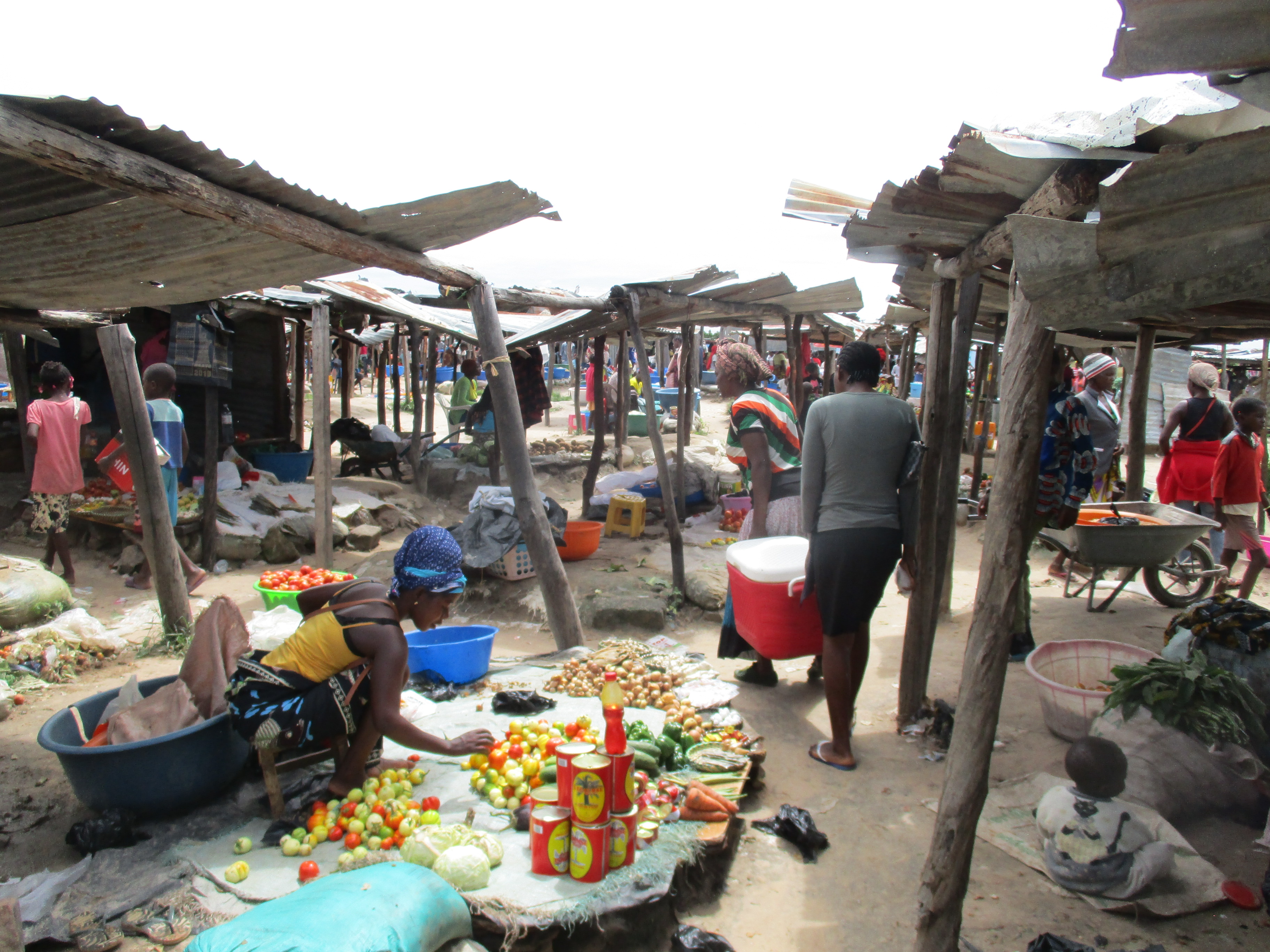
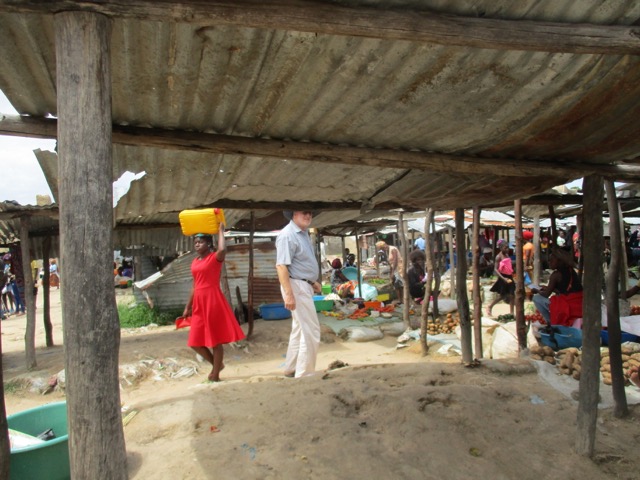
Wessel parked the truck at what I imagined to be the front of the market, but of course there was no “front.” It was just a grid of pathways with no dedicated vehicle parking, as most of the patrons arrived on foot. One could enter from any direction and navigate through the maze in any number of ways. On either side of the paths were stalls of all sizes, though most were quite small. These were made simply of four posts and a low-slung metal roof to shield merchant and merchandise from the sun. I soon learned that only small children could stand upright in these spaces. As I stepped swiftly from one row to another through an empty stall, the top of my head met the wooden beam. My neck vertebrae gave a loud crack, and the sheet metal reverberated like a sad gong. The sudden racket stood out above the din and turned a few curious heads.
A wide variety of products were available, but the most common – and the reason for our visit – was fresh produce raised by the local subsistence farmers. The sellers were almost exclusively women – presumably the men were still at home tending the fields. These farmers ate what they needed and sold the rest. Having sold their excess produce, they could then purchase what they could not grow: clothes, building materials, tools. What they sold one day would pay for their needs the next. In this manner they lived hand-to-mouth, day-to-day. That market – a central, safe location to sell and buy – was essential to their mode of survival.
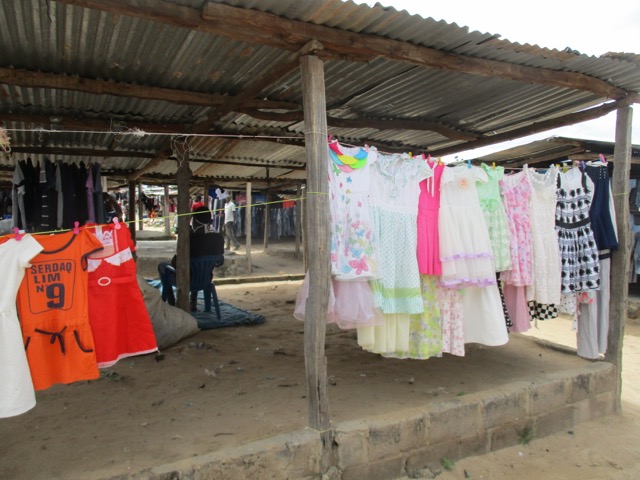
Here and there were larger, apparently well-established shops. One sold all manner of shoes, another a wide variety of clothing, and others music and electronics. There were also canned goods, auto parts, and a type of strange whiskey sold in bags. I met three shop keepers who addressed me in good English. They asked if I was a tourist or if I worked for the oil industry. I just told them that I was thinking of moving there with my family someday.
It was good that we visited the market when we did. It was closed for business when the lockdown fell. It became a hardship for many of the subsistence farmers not to be able to sell and buy there.

 Welcome to Angola