
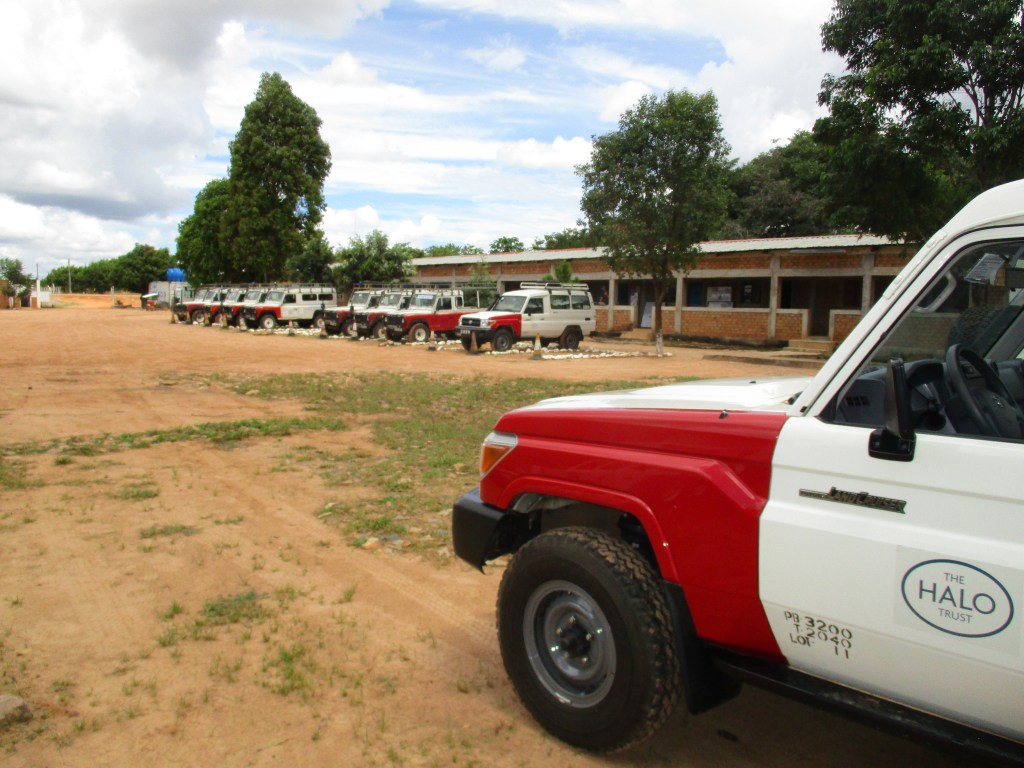
Wessel and Ericleidy drove me to the HALO Trust base, just as they had picked me up from the airport three weeks earlier. I didn’t know what to expect, but I had visions of hectic motion, packing of vehicles, and a hasty departure. Christy had made it clear that time was of the essence. I was determined that if something was going to hold up the convoy, it was not going to me. Besides, getting me out of Angola was not HALO’s top priority, and I did not want to be left behind.
History
I had learned about HALO Trust and its mission while researching Angola. The organization was founded in 1988 to combat the landmine crisis in Kabul, Afghanistan after the Russians pulled out of the country. HALO started working in Angola in 1994 even as the civil war raged, and their work in Angola had made international news a few times. In 1997 Princess Diana visited a minefield in Huambo and met with landmine victims. She brought world-wide attention to the plight of people living in mined areas, and she championed a treaty to end landmine usage. Just months after her death, the United Nations Mine Ban Treaty was opened for ratification. Her influence was a major catalyst for its creation.
More recently, the HALO Trust hosted Prince Harry as he toured Angola in 2013 on HALO Trust’s 25 anniversary, and again in 2019. He visited Huambo and retraced his mother’s steps through a minefield, which had since been transformed into a bustling city block. He rested in a courtyard next to a tree dubbed the Diana Tree near the place where his mother had been photographed a generation before. From this urban setting, the prince then visited an active minefield far off the beaten path in Dirico in the far south of the country, near the Namibia border. The royal visit renewed interest in the global demining mission, bringing increased awareness to the cause. I was about to meet some of the people who helped blaze a trail into the bush for the prince’s visit.
Entrance
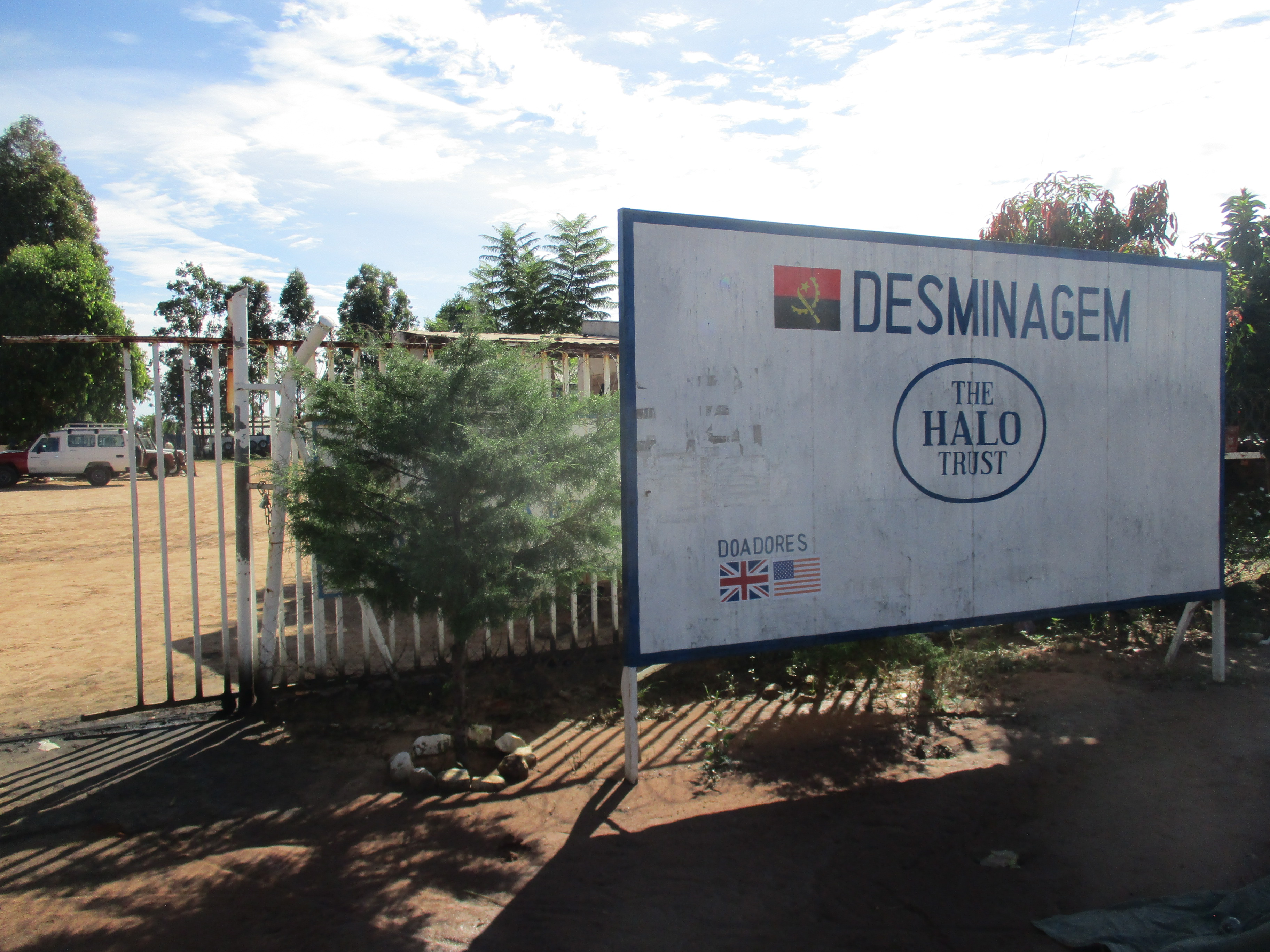
The HALO Trust base was close to a large triangular intersection near the edge of town. We parked in the lot just outside the HALO installation. A large, white sign out front announced DESMINAGEM (“demining”) next to the Angolan flag, and below that was the HALO Trust logo. At the bottom were two smaller flags, British and American, next to the word DOADORES (“donors”). Peering in from the front gate, I could see many well-ordered structures and vehicles but very little activity for such a large facility. The three of us walked to the guard shack just inside the gate and announced why we were there. As we waited for someone to come and claim me, Wessel and Ericleidy talked to the Angolan guard.
From within the base, a man walked to the guard shack. Christy would look as much at home on a military base as he did there at HALO Trust in Menongue. Trim, with shaven head and five-o-clock shadow, wearing khaki cargo pants and a grey short-sleeved shirt, he looked and carried himself like someone with authority. He seemed to wear a perpetually serious but not unkind expression. He introduced himself and exchanged small talk with the group for a few minutes. With handshakes, hugs, and a prayer Wessel and Ericleidy bid me farewell for the last time and headed back to OM base.
Christy led the way across the deserted lot toward the back of the facility. With the gravel crunching under our feet, he filled me in on the current situation. “We officially shut down four days ago. Most of the team are already gone. There are only three of us left aside from the Angolans: myself, Louie, and Giorgi. Unfortunately, the provincial governor has yet to provide us with a travel document, so it’s a case of hurry up and wait, I’m afraid.”
Layout
I surveyed the layout as we walked. On our left was a long building that I took to be the command center for the base; it was partitioned into offices, and the front was spanned by a wide veranda. A neat row of red and white Land Rovers and Land Cruisers were parked out front. Most of these were marked “Ambulance.” After the command center was a round, open-air hut with a thatched roof that looked like a resort cabana transplanted from the South Pacific. A television on the wall was switched on, entertaining no one in particular. After the cabana was a row of sleeping quarters for workers.

Command center on the right, row of ambulances in front, Ops room at the far end
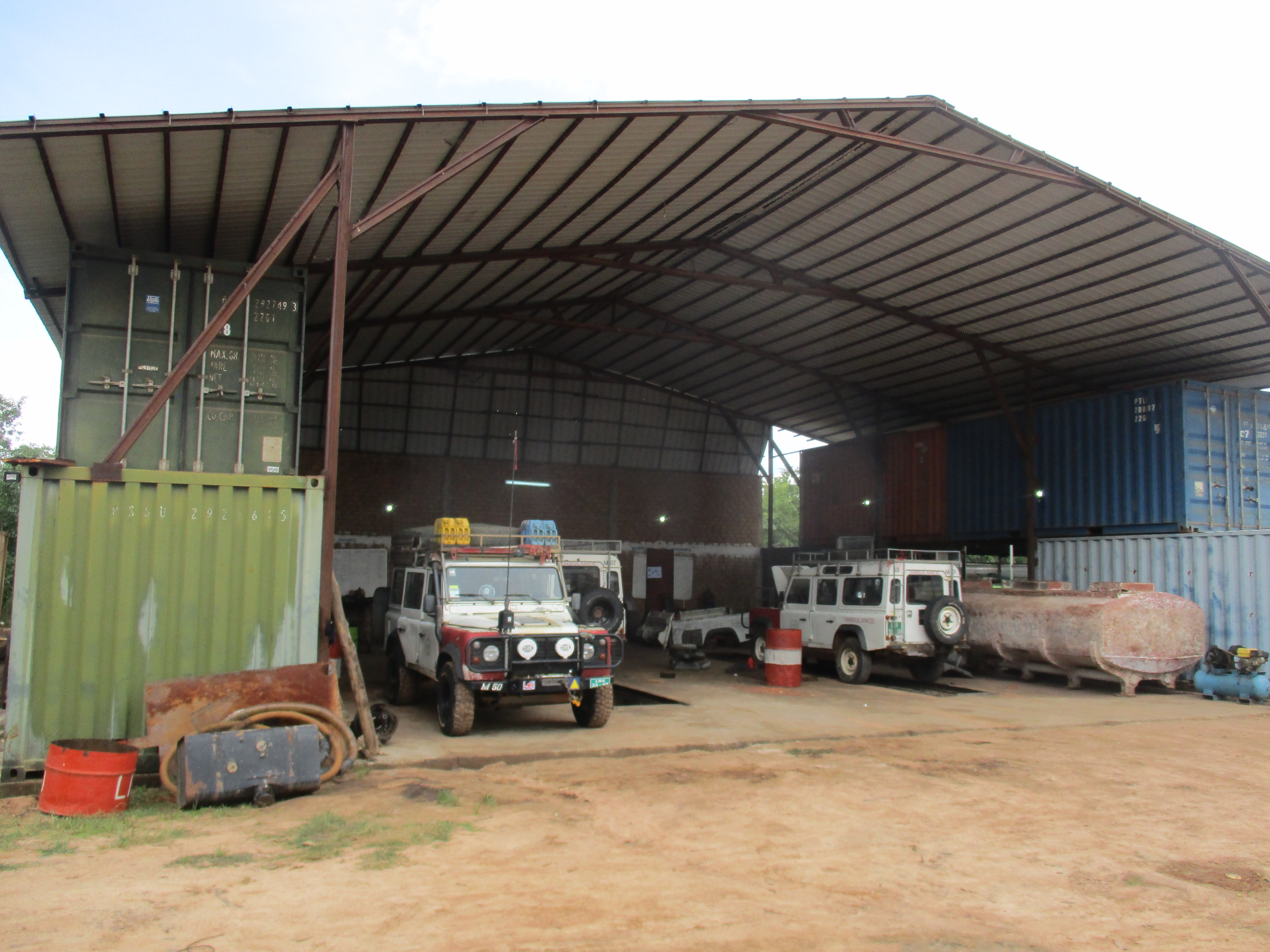
On our right was a large open-air metal structure, obviously the workshop. It was flanked on either side by shipping containers that supported the structure. Three vehicles were parked in the shop. Surrounding the workshop was an assortment of tractors, trailers, containers, and heavy haulers – older Dutch DAF trucks and newer Russian Kamaz trucks – motorized beasts able to carry tons of equipment over challenging terrain. After the workshop, toward the back-right of the base was a row of rooms with toilets and showers.
The bungalow
Christy headed straight back from the front gate to a bungalow with several more vehicles parked in front of it. The bungalow was a squat and cheery blue-and-white number, and I ducked under the low eave to avoid scraping my head. The covered porch had a single table in the center, and piled all around was baggage and gear assembled in expectation of imminent departure. The bungalow was combination mess hall, entertainment center, and sleeping quarters. The building had a certain comfortable austerity about it.

Inside, the main room was split: one side had a freezer, dining table, and water dispenser; the other had a couch, bookcase, chairs, and television. A small but well-stocked kitchen was attached to the back, and an exit at the back of the kitchen led to the rear of the building, where sleeping quarters were accessed from the exterior. Christy introduced me to Louie, the other UK citizen left on the base and the youngest among us, and Giorgi, who was from the country of Georgia and looked about my age.

 Welcome to Angola