

I was grateful for the day of rest on Sunday. I needed it more than usual. Very little happened that day. Ngunza gave a message about it being difficult to make it to heaven if we don’t have humility and faith like a child, using a reference in the book of Matthew, chapter 18. To illustrate the concept, he had made a small cardboard wall with an even smaller door. We each tried to squeeze through the “gate” to illustrate how difficult it is for big people to fit through with all our “baggage.”
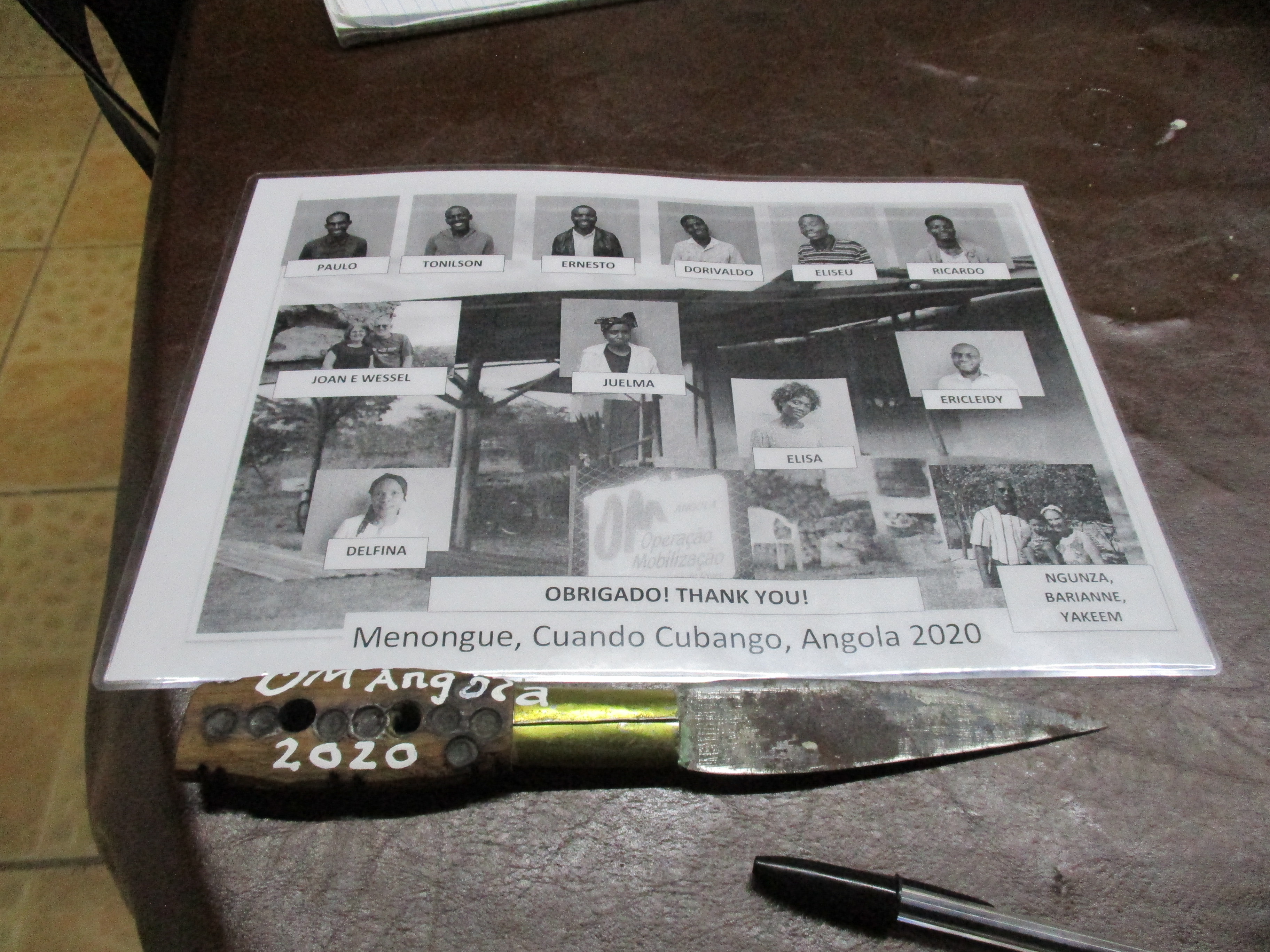
Everyone seemed to sense that my time with them was growing short. One evening, they presented me with two gifts to commemorate my time in Menongue. One was a laminated picture of the OM Menongue team and the seven mission students. The other was a hand-crafted Nganguela knife with the words “OM Angola 2020” painted on it.
Again for my evening devotions, I landed on a random verse that spoke to me:
I would fly far away and make my home in the desert. Psalm 55:7
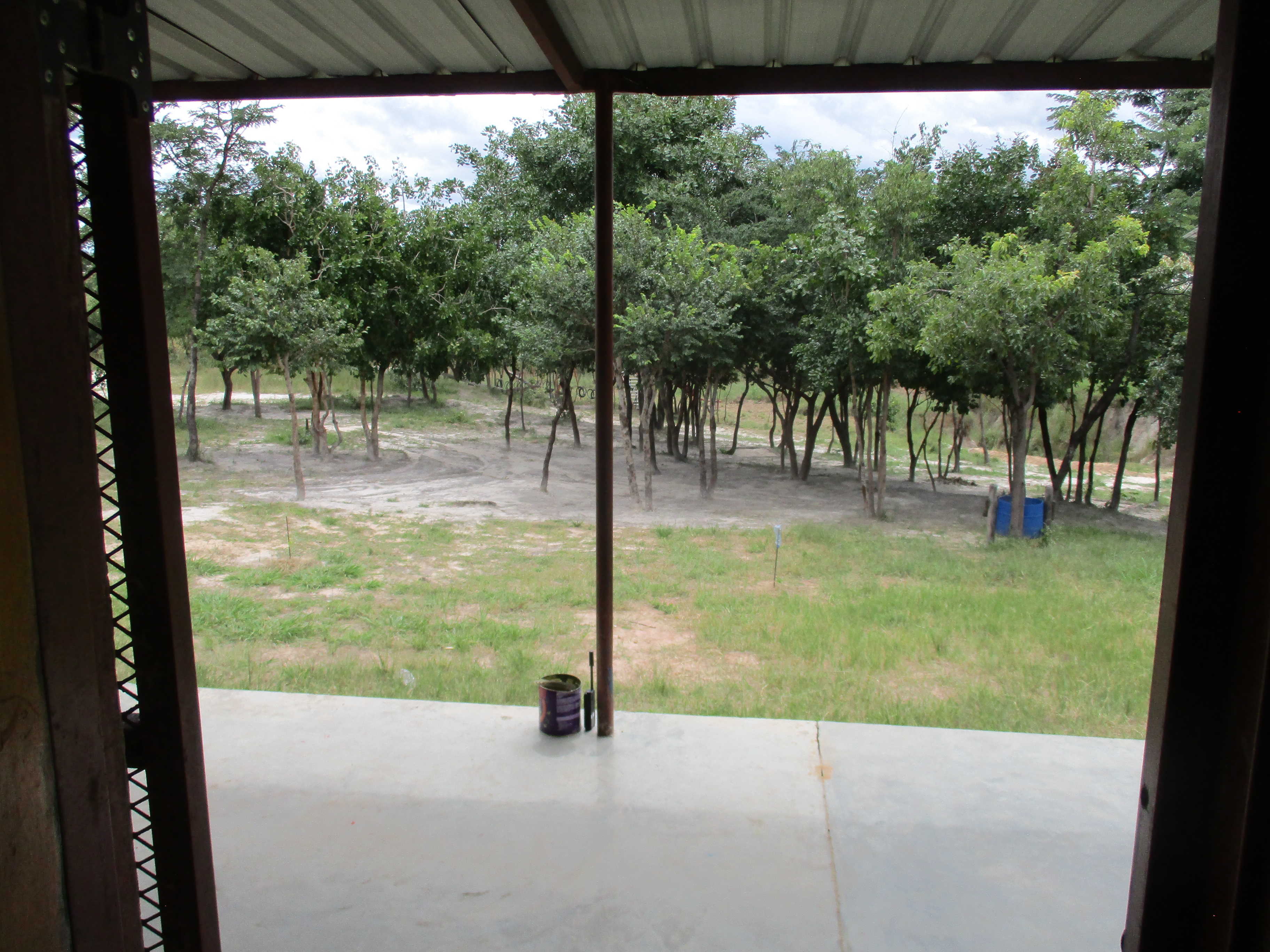
As the new week began on Monday, I continued with my job painting the schoolroom floor. It felt less and less likely that I would be there long enough to finish the job, but I kept at it. There had been little movement toward going home, but I felt that something might break at any moment. I brought the satellite phone with me to the schoolroom and left it on the front porch, switched on and antenna extended, while I painted inside. Several people also had Wessel’s number, so news might come that way. Since I had no control over events, I put it out of my mind and worked steadily on my project.
Something goes right
Getting home with my current resources was not possible; all I had was faith that it would work out. I didn’t have the right contacts, prestige, or money, and all the information I got was unreliable. That all started to change on Monday the 30th of March. Even as we tried unsuccessfully to leave Menongue two days before, unseen wheels were slowly turning. My wife and others were working to find a way, and their efforts were starting to pay off. Though I was unaware of it all, conversations were happening, and connections were being made. The pieces were starting to fall into place. The US Embassy in Luanda was at the center of the efforts, coordinating and arranging the moving parts, and that morning I made the first of several contacts that together would provide for my escape.
Embassy and Jason
After days of getting impersonal recorded messages via a generic embassy phone number, I finally spoke to Jason, one of the case officers in charge of getting US citizens out of Angola. Jason and his colleague Riquita were compiling a list of citizens in the country who wanted to leave. They were working with airlines to arrange special flights, leveraging their diplomatic contacts to further extend their reach. Most importantly to me, they were trying to find ways to get the far-flung US citizens to Luanda so they could avail themselves of any available repatriation flights. As the clearinghouse for all evacuation information, the embassy was the source of truth, and I finally had direct access to that source.
MAF and Marijn
I reached out to Mission Aviation Fellowship (MAF) again. This time I got one of the other pilots, Marijn, on the line. I was already familiar with Marijn. He had a YouTube channel, and my family enjoyed his videos, watching each one several times while researching Angola. Marijn was very polite and appreciative of my desire to be home, but the situation was the same, if not worse. Only emergency flights were allowed, and even then, not many of those were receiving authorization, even medical emergencies. He also informed me that such a flight would be costly, especially if I was the only passenger. Lastly, he shared that there was an American missionary in Huambo in a similar predicament as me. Just in case something would pan out, I sent my contact information and passport details to Marijn and waited.
Initial cost expectation
The cost to get home was really starting to add up. The embassy had given estimated costs of expected flights out of Luanda, and the numbers were discouraging. It looked like the cost to get all the way home – the MAF flight, a repatriation flight, and one more domestic flight – would come to a little over $7,000, bringing the total cost of my little scouting trip to well over $10,000. I didn’t know how I could afford such a high expense, but I tried to put that out of my mind. My wife insisted it would be worth it to have me back home.
Nathan Holland 1st contact
Shortly after that, I got a call from Nathan Holland, the stranded missionary in Huambo. His wife and two children were in Namibia at that time, and he was planning to meet them in the US. But first he needed to get to Luanda. He had heard about a flight to Portugal that might be able to get us out of Angola, assuming we could first get to Luanda. Nathan was willing to share the cost of an MAF flight if they got permission. He was by himself in an apartment in Huambo, daring to go out only when necessary, because local restrictions were severe. He had seen the police stopping people after dark, questioning them. Nathan had been in contact with several organizations, working to get out of Angola. One unlikely organization held some hope: the HALO Trust. Nathan had talked to one of HALO’s location managers, Gabrielle (Gabby), about our situation.
HALO and Gabby
It wasn’t long before I got a call directly from Gabby. She told me that HALO had several workers in Angola who still needed to get out of the country. Her team was in Huambo in the center of Angola, and another small team was in Menongue. She asked if I was interested in going in with them on a flight with Mission Aviation Fellowship. Perhaps by pooling our resources, we would have better luck getting to the capital city, and the cost would be much lower per person. I knew that with HALO Trust’s clout, MAF would be much more likely to get permission to fly, and I told her I was very interested in joining them. She told me to expect a call soon from the ranking officer in Menongue, a British man by the name of Christy.
HALO and Christy
Within a few hours I was talking to Christy on the phone. His way of speaking combined with his British accent inspired a sort of confidence that I had been lacking. He got right to the point. He said that Plan A was to charter an MAF flight. MAF would pick up the HALO workers and me in Menongue, pick up Nathan and the other HALO Trust workers in Huambo, and fly us all to Luanda from which we would each find our way home. In case that fell through, they were looking at other options as well. I was to sit tight until there was more information. He would keep me up to date on progress.
I asked Wessel the location of the HALO Trust base. It was just a few kilometers from the OM base and very close to where we had been stopped two days prior as we tried to leave Menongue.
After so many days without progress, the events of that day seemed sudden. And once things started moving, momentum built quickly. I finally had options, and it seemed likely that something would pan out soon. I was on the phone much of the day, but I still made progress on painting the schoolroom floor. Around dusk, Ernesto came to get me for dinner and helped me clean up and carry my stuff back to the house. I walked into the dining room and was setting down my gear when everyone started clapping. I didn’t know why they were applauding until I noticed they were all looking at me and smiling. I smiled back at everyone and managed to mumble a few words of thanks. I sat in my usual spot at the table and enjoyed another meal in my temporary home.
Schoolroom conversation
I awoke every morning knowing that each day could be my last in Menongue. So as not to waste the time I had left, I went back to painting the floor of the schoolroom. As I was working, Ngunza, Barianne, and Ericleidy stopped by to talk. I sat on the concrete floor, brush in hand, at one side of the room, and my three visitors stood in front of me. We all seemed to understand that my departure was close at hand, and there were some things we didn’t want to leave unsaid.
There was a nagging question that had been on my mind since before leaving America: did I have something useful to offer the mission work in Menongue? Would they think that I could be useful? I had the burning suspicion that sending money would be more useful than going myself. I had a lot of respect for the three people standing before me. I told them what was on my mind and that I wanted their opinion. I silently hoped that after the weeks we had spent together, they would feel free to speak candidly.
Barianne was the first to say something. She started off by saying that I was unlike other Americans she had met. I didn’t act like I was trying to “bring America to Angola.” She commented that too often, people come with the attitude that they have all the answers. She spoke of when she was a teacher in Namibia, and an American was hired as the director of the school. He made sweeping changes in the curriculum and teaching style. He based his decisions on what he had been taught in college, never taking the time to evaluate the local needs, and it made things difficult for everyone. She saw that I had mostly questions – I wanted to know from those with experience how to help people in Angola, and she appreciated that.
Ngunza offered his thoughts next. He mentioned that in the Bible, Abraham (Abram at the time) was called by God to move to “a land that I will show you.” Abram didn’t know where he would end up or what God had in mind for him, but he obeyed and was rewarded for his obedience. Ngunza advised that I should step out in faith and trust that God had a role for me to play in Angola.
Ericleidy’s answer was the most practical and direct. He said that Angola needed English and computer science skills, and if I wanted to come there to teach, he was all for it.
That conversation in the schoolroom meant a lot to me. Thanks largely to getting stuck because of coronavirus, I felt that my “vision trip” had accomplished its purpose. Before the borders were closed and the lockdown was imposed, I hadn’t felt for sure either way. It had been a pleasant trip, but I felt that I had not gotten to know Wessel and his team well enough, and vice versa. Getting stranded led to more meaningful experiences and conversations. The coronavirus was causing death and destruction all over the world, but God was also using it for good.
Second call from Christy
Late in the afternoon on the 1st of April, I got another call from Christy, and he laid out the plan as it stood. Getting a flight with MAF was still the primary objective. It was the easiest option and posed the least risk, but it also seemed a long shot. Even with HALO’s clout behind the request, Brent and Marijn had been unable to obtain clearance from authorities. Christy couldn’t be sure how it would play out, so he was hedging his bet on MAF by trying to get written permission from the governor of Cuando Cubango to travel overland. Even if we couldn’t drive all the way to Luanda, we could possibly get to Huambo and rendezvous with Nathan and the other HALO workers. Maybe MAF could more easily get permission if they only had to make one stop. But there was a wrinkle: MAF’s largest plane did not have capacity for everyone who wanted to leave. Christy was kind enough not to spell out what that meant for me, as the last person to get in on the venture. I might still be out of luck.
HALO Trust had a good working relationship with the governor’s office, and Christy expected to get permission to travel overland at any time. If permission did come, and if I wanted to join my fate with theirs, then he wanted me at the HALO base the next day, so they could move out without further delay. He wanted me there at 8:30 the next morning, and they intended to leave Menongue at 10:00 sharp.

 Welcome to Angola