
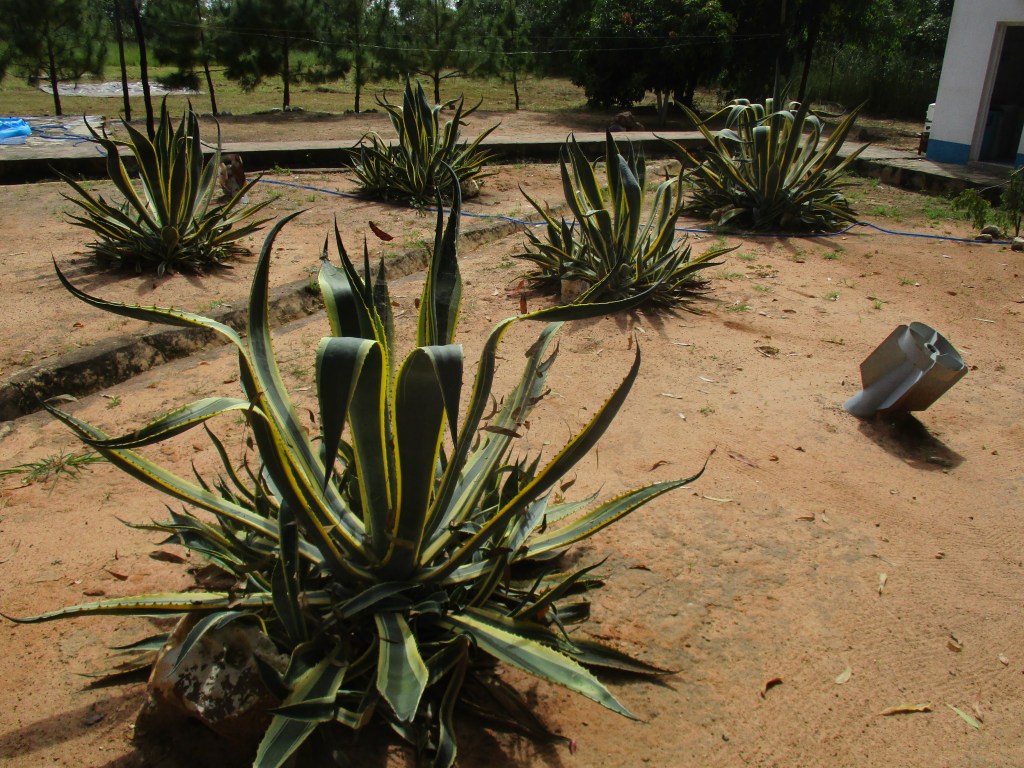
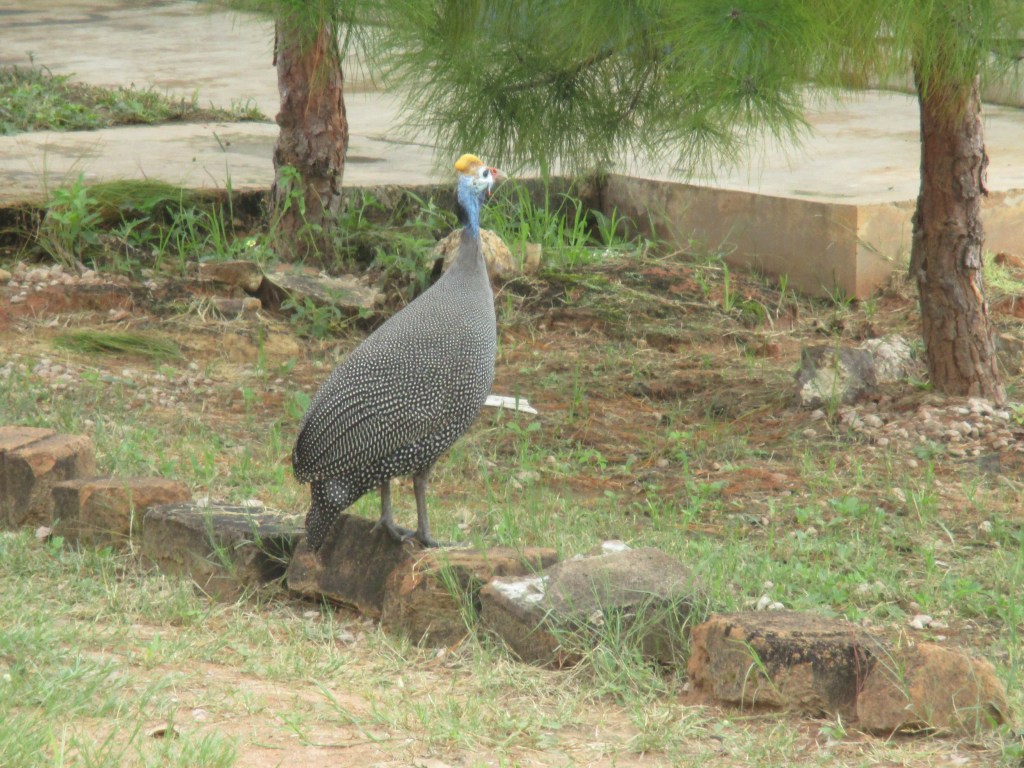
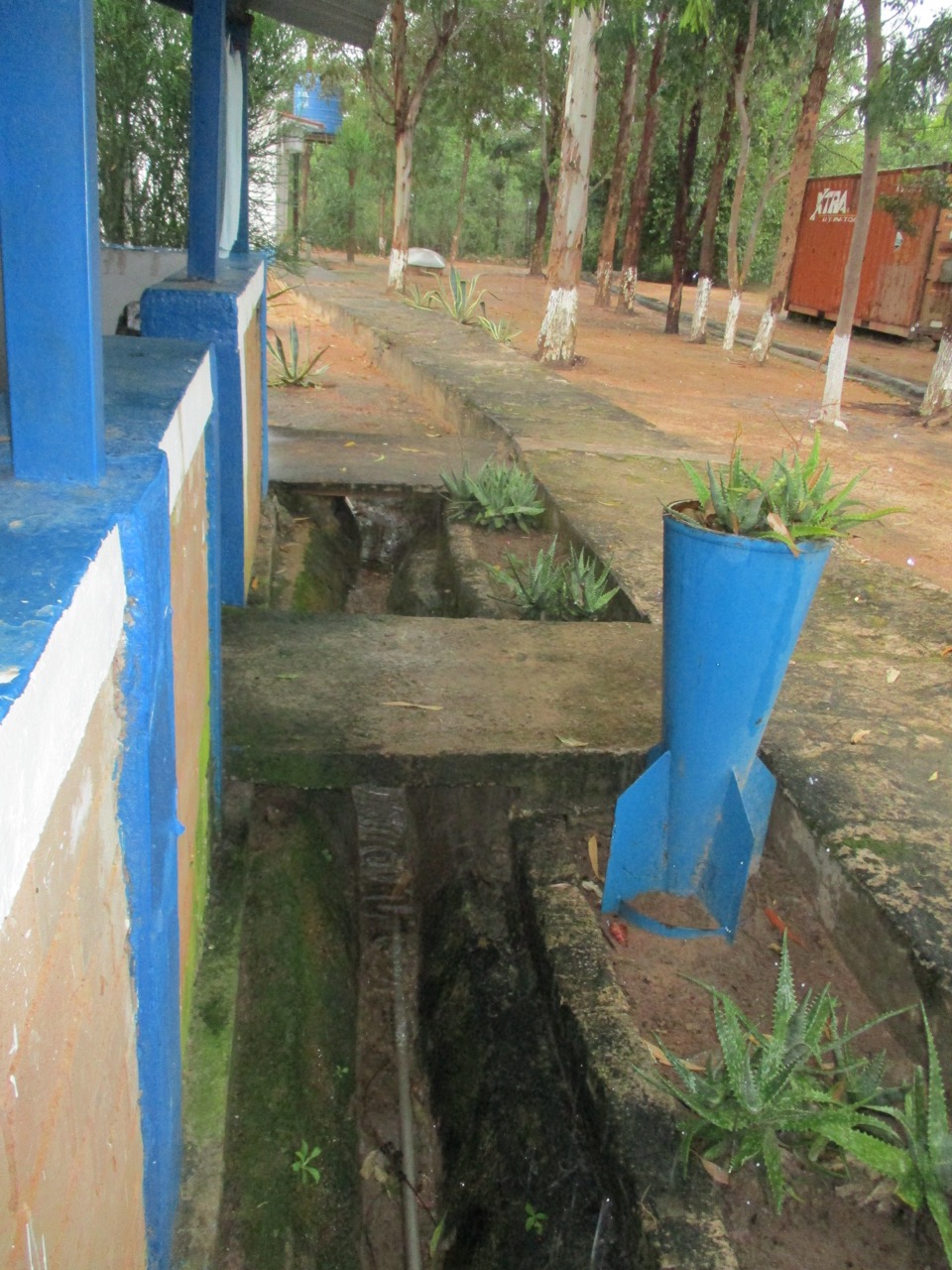
When we got back to the bungalow from the Ops room, Christy was on the phone, trying to work things out for our departure. Louie went to continue packing, and I wandered around the grounds. The planters in front of the bungalow were tail fins from bombs, their deadly warheads replaced with an explosion of aloe leaves. A courtyard stretched between the bungalow and the bathrooms. The yard consisted mostly of sand and a few large Agave plants. Accenting the area were more bomb fins, stuck in the sand as if they had been carelessly dropped there – an amusing juxtaposition to the serious work they did. A cat lazily sunned itself on the sand, and a group of guinea fowl loitered nearby.
I meandered back to the patio, and when Christy got off the phone, he announced that (paraphrased with apologies) “the word of the day is nuts.” I guess his call hadn’t gone well. There was a flight to Portugal out of Luanda in a few days, and Christy and Giorgi were counting on it to get them out of Angola. As the hours ticked away, their options – and by extension, mine – were dwindling. The overland contingency was quickly becoming Plan A.
At MAF, pilots Brent and Marijn were having no luck getting permission to fly. And besides, Christy didn’t want MAF to expend political capital on us, when there were others with more urgent needs who had no other options. We at least had our fallback plan. We just needed written permission from the governor to increase the odds of success. There had been a glimmer of hope on that front: Christy had been told that the travel document was printed up and ready to be signed. But after that, someone from the governor’s office came to the HALO compound to print the document they said they had already printed. The local government had run out of ink. Truly, “hurry up and wait” was the order of the day.
The day was wearing on. It was already past noon. When I had arrived, there was tension in the air, a sense of expectation that something might happen soon. As we realized that the odds of leaving that day were slim, I sensed a relaxing of the tension. Louie offered to make more sandwiches for a midday meal.
Patio conversation
Christy pulled a folding chair from one of the piles of gear and sat at the table on the patio. I followed his example and grabbed a chair for myself. He lit up a Supermatch Classic and commented, “So Louie gave you the grand tour?” I commented on the large maps and the many colorful dots all over the country. He responded that they had enough work to keep them busy for at least 25 years at the current rate of funding. That’s some serious job security, though their goal is to put themselves out of work.
Funding
Speaking of funding, Christy said HALO had three main sources of financial support. Governments and institutions provide the bulk of HALO’s support. A second source is “high net worths,” wealthy individuals who want to make an impact or leave a legacy. They could make an undirected donation, or they could earmark the funds by selecting a region or a specific active minefield to “sponsor.” Such an agreement would define how much area would be cleared in return for the donation. It’s like a high-stakes “Adopt-a-Highway” program with more meaningful and long-lasting results. Really big donors (or their representatives) might visit one of HALO’s sites around the world and get a tour of the facility and operations to experience first-hand the incredible work that HALO does.
On very rare occasions and at their discretion, HALO might bestow the privilege of detonating an uncovered mine in an active minefield. Such an honor could impress a government official or seal a deal with a potential big donor. As Christy put it, “I don’t care who pushes the button” once all the hard work is done, and the experience leaves quite an impression on the visitor. I asked him if I could visit an active minefield if and when I returned to Menongue, and he said (let the record show) that it was a distinct possibility. A third and very significant source of donations is regular private citizens who want to partner with the HALO Trust to make the world safer. If you want to learn more, visit halotrust.org
Locals and safety
Christy said that Angolans are hired to do the demining work, and Louie and other experts deal with disposing of firearms and other unexploded ordnance that are unearthed. HALO Trust is one of the largest employers in Angola, and a sizable portion of the workforce is female. The demining jobs are coveted positions. The pay is good, and the work is consistent. And with all the training that deminers receive, the work is relatively safe. In fact, HALO boasts a better safety record than many of the big oil companies. Not bad, considering HALO deals mostly with explosives.
Christy, the man
As we talked, I got to know a little about Christy himself. His work title is Global Fleet Support Officer. He is responsible for fleet logistics for HALO Trust vehicle assets across the globe. As he put it, Angola is his baby, having started his HALO career there as a workshop manager in 2013. HALO has several bases in Angola, strategically located in provinces where there was heavy fighting during the civil war. Operations shift and priorities change as old minefields are cleared and new ones are identified. Christy had lately been splitting his time between Huambo and Menongue. His home was near the southern coast of England, and he had a daughter the same age as one of my girls. Before coming to work for HALO, he had worked in many countries and industries. He was only a decade older than me, but with vastly broader experience.
Christy was the self-proclaimed “grumpy old man” of the team. He jokingly explained, “When I tell them how to do something, they ignore me and do it however they like. Not like I have decades of experience or anything. They’d rather make their own mistakes.” Despite the ribbing, there was an obvious mutual respect among these guys. They had a good team assembled, and there’s not much room for ego in their line of work.
As I learned more about his long, globe-trotting career, I asked him, “What does a guy like you do when you retire? Or does a guy like you retire?” He thought about it a few seconds and gave an answer that satisfied my curiosity.
“I don’t know. Probably go fishing.”
This is Africa – the house always wins
At one point, Christy said of Africa, “Bring your best to Africa, but expect the house to win. Like the house robots on Robot Wars. The house always wins.” I understood that reference, thanks to American public television. In my younger years, the Public Broadcasting Service (PBS) in my area had a Saturday night lineup of amusing Canadian and British shows, and that included Robot Wars, which was a sort of battle royale for remote-controlled machines built by robot enthusiasts. Aside from battling each other, the amateur robots faced additional hazards in the form of the “house robots.” Professionally built and overpowered, the house robots would attack competitors that wandered into their territory or became immobilized. No matter how good the challengers were, the house always won.
Christy expanded my vocabulary with some new acronyms. AWA (pronounced ay-wah) is used when things go wrong – Africa Wins Again. And when things inevitably do go wrong, don’t get angry. Just grin and remind yourself, T.I.A. – This is Africa. To survive in Africa with your sanity intact, embrace these mantras. They are not used in a derogatory sense, but instead they are reminders to relax, be patient, and not let things get to you. You can’t control things, so just enjoy the ride. It’s part of why Africa is so mysterious and endearing. Those who choose to live there either adapt to it or go crazy trying to control it.
The title of this book came directly from one of Christy’s personal encounters. He had witnessed a government official receiving a visitor to the country with the greeting “Welcome to Angola. Something always goes wrong.” As I had done many times already, I recorded the amusing anecdote in my journal. As he eyed me scribbling for the hundredth time, he remarked, “Taking more notes for your tell-all book?” At that moment, the thought crystalized in my mind to create the work you are now reading.

Not for the faint of heart
Christy stated repeatedly that Africa was not for the faint of heart. Overconfidence and lack of preparation lead to AWA and TIA situations, especially out in the bush. Christy had encountered many people in his travels. Some seemed to have an air of competence about them, and others, not so much. He had observed that many people try to prove themselves through contrived or artificial situations. Apparently, modern Western life offers few genuine challenges. He mentioned three types of people who stood out.
The first of these is the Bear Grylls type. These folks are gung ho, ready to take on any challenge, but not necessarily aware of what to expect. Perhaps Africa’s challenge for you today involves queuing for 6 hours to get your automotive paperwork approved, not facing down a hippopotamus. These are the ones who get excited at squeezing water from a fistful of elephant dung. “Um, would you like a bottle of water?” The second is the Survivalist – the one who wants to run into the bush and find some sticks to rub together to get a fire going so they don’t freeze at night. “You know we have matches, right?” Are there not enough real problems on hand that you must imagine new ones? The last type is the off-road enthusiast. “The one who makes it through Africa with the best toys, wins” – that sort of thing. They come in with fancy vehicles, talking about this performance upgrade and that aftermarket part.
Christy posed the question, “Well, what about when there are no parts available?” He gave an apt example. When the large HALO Trust convoy was leaving for Dirico to prepare for Prince Harry’s visit, they had made it barely 20 kilometers out the gate when one of the vehicles broke down. Instead of losing time going back to base to repair it, they rigged up a lift and fixed it on the side of the road. That’s the kind of resilience that will get you through Africa in one piece.
I never asked him what he thought of me, trying to bring the gospel, English, and computer science to rural Angola. Who knows, maybe now he has a new type of odd-ball visitor to talk about.
National Geographic and the Okavango
Christy mentioned that two of the Land Cruisers parked in front of the bungalow belonged to “NatGeo” – the National Geographic Society. The vehicles had been left at the HALO base for safekeeping. One had a flat-bottom canoe strapped to its roof. National Geographic and HALO Trust have a history of working together in Angola.

In 2015, a team from National Geographic approached HALO with a request. The Okavango Wilderness Project had an ambitious plan: to find the source of the Cuito River in central Angola and follow it through Namibia to the sands of the Okavango Delta in Botswana. Researchers had been documenting a decline in biodiversity in the delta, one of the last wilderness wetlands in the world. The delta is a massive “alluvial fan” in the middle of the Kalahari Desert, an oasis with seasonal ebb and flow that is home to some of the largest animal populations in Africa. To understand the decline in the delta, they needed to understand the Cuito ecosystem that feeds it. They were organizing this “source-to-sand” expedition to make a thorough evaluation of the waterway, making a detailed survey of the wildlife along the way. They needed HALO’s knowledge and expertise to safely guide them through mine-infested areas to the source of the Cuito.
The HALO team not only found and marked the starting point of the expedition, but they also provided logistical support and an escort to insert the team of researchers safely beyond the curtain of landmines. From there, the National Geographic team traveled by mokoro, a fiberglass canoe inspired by those made of wood by the local baYei river bushmen of Botswana and Namibia. The mokoros’ flat bottoms were ideal for poling through the shallows of the river, though the crew spent an unexpected amount of time dragging the boats until the river grew enough for them to float. The expedition took four months to travel the length of the river system to the Okavango Delta. The crew of explorers, biologists, and other experts – led by South African conservationist Steve Boyes – included a young biologist, Adjany Costa, from Angola, and a Botswana native nicknamed “Water.” The result of the expedition was the most comprehensive survey of the delta ever conducted, as well as a National Geographic special “Into the Okavango” released in 2018.
Paging Mrs. Christy
Our immediate goal was to get to Luanda, but none of us were certain how we would ultimately get to our respective homes. As already mentioned, one promising flight was going to Portugal. Though there was a threat of quarantine in Portugal, some were willing to take that risk. When Christy’s e-ticket to Portugal finally came to his phone, he was less than amused. “You must be joking. It’s made out to Mrs. Christy Phillimore.”
Rare opportunity
As I talked to Christy and Louie about Africa and Angola and HALO’s mission, it occurred to me that this experience would have been impossible at any other time. Louie would be working in the field, and Christy would be too busy to entertain an unknown visitor. I enjoyed unhindered access to these experts. Their unique perspectives and advice were invaluable. And it’s not like they had much else to do. They were a captive audience.
But then again, so was I.

 Welcome to Angola