
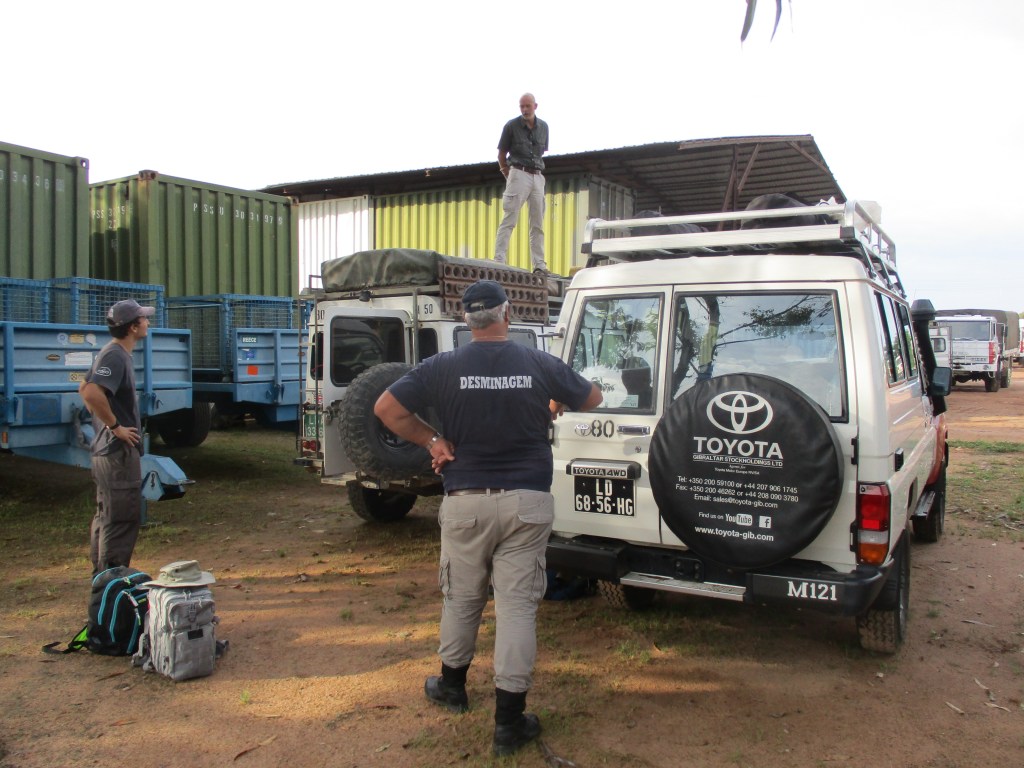
Preparing to leave
In the morning, the first order of business was to get everything loaded up. The governor had not yet signed our overland authorization, but we were not going to let that deter us. Not content to waste another day waiting, Christy was determined to set out for Huambo that morning. He and Louie had tickets reserved for a flight to Portugal, Giorgi was hoping for a flight, and I was eager to be near the American Embassy in case a rumored flight from the Congo materialized. Even without the written permission, we had a lot going for us. First, we would be traveling in HALO-branded vehicles, which would carry a certain cachet all by itself. Few people in the Angolan police force wouldn’t know about the essential work they do. And second, we had supporting documents in the form of travel itineraries and letters from our respective embassies. Written permission from the Angolan government should just be icing on the cake. The plan was to hit the road by mid-morning fully loaded. We would make a stop at the provincial governor’s office and try to get our proverbial hall pass, but we were ready to roll on and take our chances.
We hastily prepared the place for the prolonged absence. All spare gear was stowed in a shipping container behind the bungalow. I packed up the television, DVD player, and cables, and Christy handed me the keys to put it all in the container. Louie brought some more items for the container, and it was locked for safekeeping. Louie whipped up another round of bacon sandwiches for breakfast and some for the road. As we all had a quick bite to eat, someone asked if I wanted something to drink on this special occasion. I mentioned that I hadn’t had a soda in a while, and they scrounged up a Coca-Cola that had been left in the freezer and burst. I drank it as it thawed.
I made one more stop at the bathroom that morning. In the light of day, I could see a gas tank high on the outer wall of the shower room. On a hunch, I turned on both taps in the shower and let it run for a while. Sure enough, there was hot water. I didn’t share my amazing discovery with the others, nor did I mention the cold shower that I had enjoyed the previous evening.
Two vehicles had been prepped for our departure and were parked in front of the bungalow, waiting to be loaded. One was a Toyota Land Cruiser, and the other was Christy’s longtime personal vehicle, a Land Rover. The Rover was only four years younger than Christy and had been with him through many years and countries. Since Louie would be staying in Huambo, we filled a portable refrigerator with all the frozen meat and vegetables that we could jam in it. We then heaved the fridge into the back of the Land Rover. All the gear and personal belongings that were piled on the patio quickly followed, and both vehicles were soon full. All that remained to be loaded were my two small packs on the ground.
Heading out
Christy climbed atop the Rover and checked that everything was secure. He turned to face the three of us on the ground, looking like a commander addressing the troops. If I didn’t know better, I’d say he was enjoying himself. Apparently satisfied that all was in order, he made his announcement short and sweet, “Let’s get this coronavirus convoy on the road.” Just after 10 that morning, Christy and I climbed into the Rover, and Louie and Giorgi got in the Toyota. HALO Trust was emblazoned on the sides of both vehicles. I was feeling confident. This might work.

“Let’s get this coronavirus convoy on the road”
We drove the short distance through Menongue to the governor’s office. It was a pink building with red tile roof, like all the government buildings. We had everything in order, including a list of who was riding in which vehicle. Christy went in alone to get the document. He came back in 20 minutes, signed approval in hand. The only hitch was that it swapped the occupants of the vehicles. We didn’t bother complaining.
Travel papers in hand, we finally headed for the roadblock at the edge of town. Uncertain what to expect, we pulled up to the blockade. With one glance and a salute, the guard moved the barrier out of the way, and we rolled right through. Yeah, this just might work. Soon we were moving swiftly along the highway. Christy commented that he hadn’t bothered to fill up the truck’s gas tank. He got on the radio to the other guys and announced, “I thought I would make this more challenging, so I didn’t fill up on petrol.”
On the highway
The highway stretched to the horizon. People were walking in both directions. I assumed as we went further out of Menongue that the number of people walking would decrease. But mile after mile, we still encountered lots of people along the road. It seemed incredible that this might be a daily or weekly commute for these people. But where were they coming from? Of course, I had gotten used to people walking everywhere in Menongue, but it was strange to still see people walking so far from any city. I marveled at how much of their lives must be spent traveling. How did they have enough time left over for all the other demands of life?
Here and there people were congregated at the side of the road at a sort of ad hoc market. Some were selling produce, and others were drying grains on blankets spread on the hot road. Massive bags of some unknown product were also for sale. These roadside markets seemed to spring up in the middle of nowhere.
Christy started to fill in the gaps of my understanding. He pointed to a blue car door hanging from a tree just off the road, “You see that? It marks a path. If you walk straight back into the trees, you will find a village. That door is a road sign.” That explained how so many people congregated in seemingly random areas. Tucked back in the forest were villages, some kilometers away, predating this modern highway by unknown centuries. And they needed a way to mark their locations. This one was a car door; another might be a bucket or an animal carcass or random piece of metal. It also explained how there could be people on every stretch of the roadway. They were walking back and forth from their homes, hidden far back in the forests and grasslands. He talked about how the villagers must navigate two distinctly different worlds, one ancient and the other modern. In the ancient world of their village, they may still wear nothing more than a string or a loincloth and live much the same way as their ancestors did. But when they emerge from the forest into the modern world, they deal with seemingly arbitrary contrivances and rules, including laws that require them to cover themselves while in “public.”
Roadblocks and sunglasses
After a while we came to another roadblock. This one was on the border between two provinces, and it was obviously not going to be a quick stop. All manner of vehicles were halted here, from small cars to large tankers. Our small convoy pulled over, and the four of us crossed the road toward a table under a canopy. I noticed with regret that I had left my regular glasses in the car, and all I had was my prescription sunglasses. Not wanting to turn around in the middle of the road, I kept walking. We were directed to wash our hands. An official aimed an IR thermometer at my head and pulled the trigger. I nearly flinched at that gesture. We were each handed a scrap of paper with a number scribbled on it, presumably the thermometer reading. We then each produced our passports, and another official wrote down some details from them. We were then free to go, and I was eager to get back to the truck, resolving not to leave my regular glasses behind again. But then Christy struck up a conversation with one of the guards who he had recognized. We stood in the hot sun, talking about current events, the weather, and social happenings. I knew it was impolite to keep my shades on, but if I removed them everything would become a hopeless blur, making eye contact impossible anyway. Rather than squinting at the blobs around me, I just kept them on and hoped nobody would notice.
Flat tire
At length, the conversation ended, and we continued on our journey. We didn’t get far. Barely out of sight of the roadblock, Christy pulled over, commenting that the Land Rover was driving funny, and the other vehicle pulled in behind us. We had a flat tire. Wasting no time, Christy detached the high-lift jack from the roof of the Rover and connected it to a slot in the frame. He started to raise the heavy vehicle, but then the jack stopped ratcheting. The mechanism was gummed up with oil and road dust. Some silicone spray helped, but the catch still required manual resetting with each pull of the lever. Louie and I both tried to reset the stubborn thing, but it wouldn’t budge. Christy forced it to work, and soon we were again heading north.
Charcoal and deforestation
At intervals, I could make out wisps of smoke rising from the forest, far from the road. I had conjectured that they were forest fires, and I was sort of correct. Christy offered, “They’re making charcoal.” They burn old trees, reducing them to charcoal. They then bag up the chunks and sell it. It’s one of the ways villagers make money, but this deforestation is yet another threat to Angola’s biodiversity. It also explained the gigantic bags of mystery product I had seen people selling by the side of the road. The practice also represents another way that the have-nots are at an economic disadvantage, because they have no way to transport the finished product to the cities where demand for charcoal is highest. Truck drivers making deliveries to southern Angola take advantage of that fact. Once they have unloaded their cargo, they drive back empty. They buy the charcoal at a low price and sell it in Luanda at hundreds of percent markup. The locals have no bargaining power, so they take what they can get. The truckers have already been paid for making the delivery, so the high markup represents pure profit for them.
Old and new
Again, I was fascinated by the coexistence of old and new ways of living. Angola has many marks of the modern world. Cities and towns are connected by a network of high-speed roads. Trucks bring modern products to modern stores like Shoprite. Tankers deliver fuel to make modern machinery work. The subsistence farmers intersect with this network, but they are not first-class citizens in the economy. They rely on a short and fragile cycle: grow crops, eat to live, sell the rest, buy what cannot be made, repeat forever. They live hand-to-mouth, and in that mode, only now matters, and planning for the future is largely futile. Even something seemingly innocuous like a law requiring “modern” clothes in town becomes a real hardship. In this and other ways, the developed world makes demands on their resources that their ancient mode of living was never meant to satisfy. They are expected to bend to the rules of modern society, but without the benefit of fair participation in the modern economy. It is a vulnerable segment of society, and coronavirus restrictions were throwing off the delicate balance of their lives.
We passed more roadblocks. Most of them were easy, and most of the sentries merely regarded us with mild interest as they let us pass. As he pulled up beside the guard at one blockade, Christy reached for his sunglasses as he made the remark, “Now we put on our sunglasses so we can take them off to show respect.” Apparently, my previous transgression had not gone unnoticed.


 Welcome to Angola