
Villages and sobas
As we drove, I could see a few villages from the road, partially obscured by the foliage. The villages were comprised of no more than a few dozen small homes, even simpler than many I had seen in Menongue. They were made of mud or sticks and covered with grass. Durable materials like concrete, brick, and metal were not common that far out of town.
Christy remarked on these villages. He said the leader of one of these small villages was called the “soba.” He made all the important decisions in the community, including who could live in the village, where to build communal structures like schools, and where each family would get to build their hut. His position carried a great deal of prestige in the isolated world of the village. Gaining a prime location to build a house might require a donation of a goat or other valuable item to the big man.
The soba was invariably the richest man in the village, and you could recognize him instantly by the oversized military-style hats that all sobas wear. He could be capricious and his judgment arbitrary, but his decisions were incontestable. To challenge the soba might mean finding a new place to live. Living in the bush, there is safety in numbers, so living in a village with others is essential.

German Rock and other natural beauty
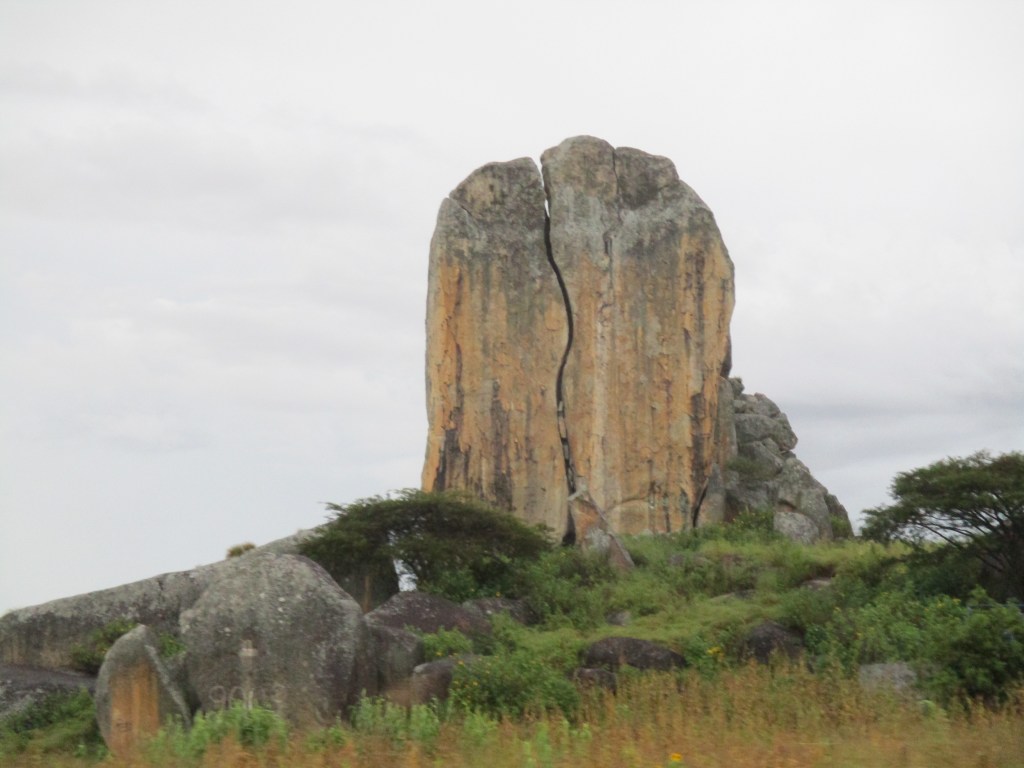
The beautiful Angolan landscape kept changing as we drove. In one area, the grassland was punctuated by huge boulders rising out of the ground. As we neared Huambo, a distinct rock loomed into view. It had a wavy crack down the center from top to bottom. Its peculiar shape had given it a reputation in local folklore. Christy had heard that it was called “German Rock” so called because a German officer came to Angola after one of the world wars and threw himself off the top of that rock to his demise. I later learned from two Angolans who lived in Huambo that the rock was known there as “German Foot” because the right side of the rock looks like a malformed foot. (Since hearing that, I can’t not see the foot.)

Angola is a land of tremendous natural beauty, and I was drinking it in as we drove, thankful to be traveling through Angola in the daylight. Wide, flat savannah would turn into dense forest, which would give way to gentle hills and sparse trees. Then the landscape would transform into a series of rough escarpments jutting up from the ground, layered one behind the other. Mountains rose in the distance and slowly grew bigger as we drew near. We passed beautiful valleys with lazy rivers meandering through them, lush green foliage growing profusely on their banks.
Retirement home
As we drove past these wonders, Christy rhapsodized how a person could make quite a comfortable life in Angola with a modest investment. Buy some land near a river, just around the bend, out of sight of the road. Build a simple mud brick and tin roof house. Add some solar panels and a water tank, some wires and pipes. Labor can be had for a few dollars a day. Grow staples in the garden and eventually expand to include cash crops to sell. Expand the house over time; mud is a versatile building material. Add a bedroom here, a sunroom there. Live close enough to a city to buy supplies, but far enough away for privacy. It sounded like a dream. Indeed, the cost of such a plan in the US would be so expensive, I could only go on dreaming. But such an idyllic lifestyle could be made a reality in Angola. Someday tourism, industry, and commerce will come and lay claim to the land. Regulations and building codes will someday make such a plan more difficult. But for now, it is still attainable by people of average means. I remarked to Christy that he had clearly given his plan some thought. He alluded to the fact that there was only so much stimulation to be had in the evenings. He needed something to keep his mind busy.

The idea of retiring in Angola made me think about Christy’s family in the UK. I asked if he ever thought of bringing them to Angola. He thought his daughter might be too young yet for such an experience, but he seemed to like the thought of her living there someday. Christy is obviously comfortable in Angola. After years of working for such a noble cause, he has earned his name a good reputation. Any child of his should be quite welcome. If I do make it back to Angola, I hope to find him still there. Maybe someday I will visit him and his family at a simple home around the bend of a lazy river. Maybe do some fishing.
Prince Harry’s visit
Our talk turned to Prince Harry’s recent visit. Christy spoke of the task of preparing the way for the prince in such a remote location as Dirico in far southern Cuando Cubango province. He tried to express the magnitude of the undertaking, the large convoy of trucks and the small army of personnel that it took to blaze a safe trail through the bush. And that was on top of the typical logistics that go into such a royal visit. All that behind-the-scenes work made the visit look easy. Some assumed that Christy, as a fellow Englishman, would be the prince’s driver. Instead, Christy had one of the Angolans act as chauffeur. His rationale was: the prince is coming to Angola, why would he want someone from his own country driving him around? I had already learned that Christy didn’t like to draw attention to himself, preferring to work behind the scenes making things happen. By his evaluation, the visit had been a big success, exclaiming, “No one knew Dirico even existed a few months ago.” It was a definite boost to HALO’s public image. Marijn with Mission Aviation Fellowship had been on location at Dirico in case emergency medevac was needed, so MAF and their mission had also been in the spotlight.
The rains down in Africa
In the afternoon, we could see a storm gathering ahead of us on the left, and it looked like we would intersect it. After about an hour, the first drops started hitting the windshield, and soon it was really pouring down. Christy enlightened me on how unpleasant it can be to drive on Angolan roads while it’s raining. He pointed out that once the potholes fill up, it becomes very difficult to tell where they are on the wet road. That of course greatly increases the odds of striking one of those wheel-wrecking holes. At that moment, I understood what they had been warning about at OM base when we tried to drive to Luanda at night. It made me appreciate even more what Wessel had been willing to risk to get me back to my family. A slight clearing of the throat, and Christy announced, “I should point out that this vehicle is not what you would call waterproof.” As if on cue, a stream of rainwater came through a gap between the door and the frame, and onto me. The weather would have to do better than that to dampen my spirits. Spurred on by a global pandemic, caravanning across Africa – I hadn’t had such fun in a long time.
Tile factory and new roads
Christy pointed out one of the last few tile factories in Angola that still made the red curved roofing tiles that are seen on the colonial-style buildings. When they left Angola decades ago, the Portuguese left more than just their language and their love of bureaucracy; they also left their style of architecture. In Menongue, very few structures still had tile roofs, mostly just the government buildings with their pink walls. But as we neared Huambo, and later Luanda, I would notice more and more buildings – from old villas to new apartment buildings – still covered with the classic colonial tile. Christy shared that when then-president Jose dos Santos’s wife had visited such a factory, they paved a brand-new section of road just to impress her. He commented on how silly it was to go through all that effort for one person. With a bit of a grin, I pointed out that it was not very unlike what HALO Trust had done for Prince Harry. He smiled and replied, “Fair enough.”
The rest of the trip was uneventful, and Christy expressed surprise at how fast we made the journey. Apparently, even with coronavirus blockades, the long trip to Huambo is getting faster, thanks to the improving roads.
Huambo arrival and Diana Tree
As we came to the outskirts of Huambo, Christy pointed out how much the city had grown just in the few years that he had worked there. There were new businesses, schools, homes, factories, and even a laboratory. Princess Diana, the HALO Trust, and others had worked hard to move the landmines out of the way and give the city an opportunity to thrive, and the Angolan people have the capacity and drive to build the future. There is a street in Huambo that bears Princess Diana’s name, and a tree dubbed Diana Tree where she was photographed in 1997 and where her son had recently visited. That corridor used to be a minefield, and now it is part of a safe and growing city.
It was cloudy when we entered Huambo. We went straight to the HALO Trust living quarters, dubbed “Casa Branca,” which was separate from the working HALO base in Huambo. The HALO team would spend the night there, and Louie would remain in the morning to hold down the fort. I would continue on to Nathan’s apartment to spend the night, but when I got Nathan on the phone, he was unable to come fetch me. Tired though he was and no doubt looking forward to a well-earned rest, Christy’s good nature prevailed, and he offered to take me the last mile to Nathan’s apartment.

The drive to Nathan’s home was made more difficult by a seemingly random series of unmanned barriers set up around the city, presumably as a coronavirus precaution. But the blockades never seemed to keep us out of an area, they just made it more difficult to get anywhere. By taking a long route around several obstructed streets, we at length arrived one block from our destination. Nathan came down to get me, and we all agreed on a time to meet back at that same spot the next morning. I bid goodnight to Christy, sincerely thanking him for his help. Nathan and I walked the nearly empty street to his building and went up to his apartment.
Nathan’s apartment
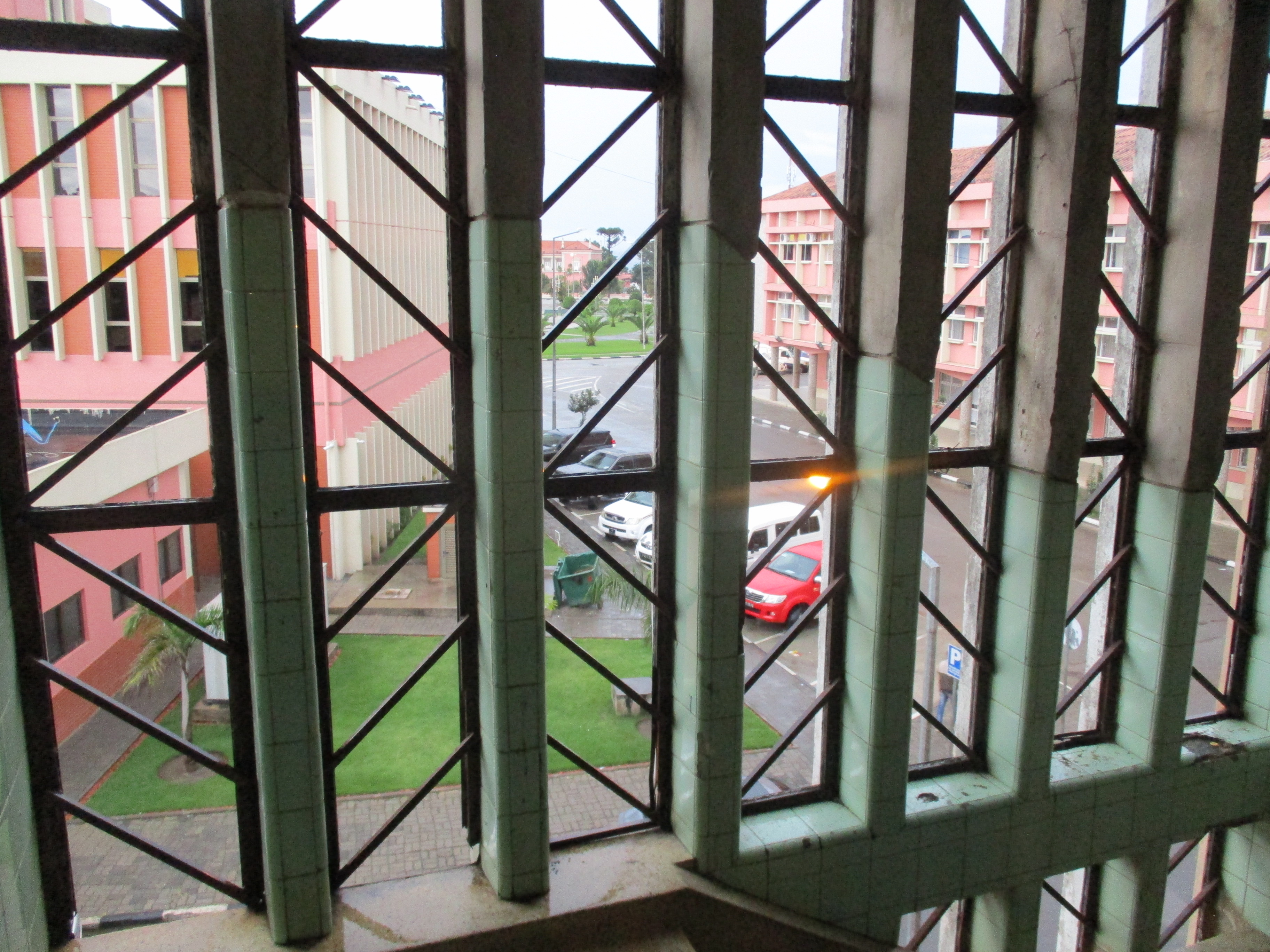
Nathan showed me around his apartment and offered me something to eat. He said to make myself at home, and he offered an old laptop so I could check my email and look for flights. He told me that at that moment, his wife and two daughters were heading to the United States, and he was trying to join them there. He had been stuck in Huambo, unable to get to Luanda and afraid to venture into the city for anything but necessities. While I busied myself on the laptop, he made final preparations with his landlord for his prolonged absence. He also reserved an apartment in Luanda for the week and arranged for a friend of his to pick us up near Luanda the next day.
Nathan’s apartment looked more modern than I was expecting. The living room boasted recessed LED lighting. An old elevator shaft went through one corner of Nathan’s apartment, and there used to be a wall blocking it off. Nathan had torn down the wall, added a floor, installed lighting, and made it into an office. He had applied similar innovation to the rest of the apartment, expanding and modernizing it. He was leaving the place in better condition than he found it.
It soon grew dark, and he offered me the couch and some blankets. Knowing we had an early morning and a long day ahead of us, we turned in quickly for the night.

 Welcome to Angola