
Visa and immigration
The overnight flight to Luanda was over 8 hours long, but I was quite comfortable. The plane was less than half full, so I could stretch out and relax. By the talk around me, I could tell that I was in the minority of passengers who were neither Angolan nor in the oil industry. As we drew near the capital city, Luanda, the flight attendants handed out customs forms and the anticipated “health control” form for us to fill out.
Stepping off the plane in Luanda, the air was humid. The morning sun was just starting to heat up the tarmac as the passengers trudged toward the nearby row of buildings. Inside, we were greeted by a maze of rope aisles snaking back and forth across the room. No doubt it was cooler inside than out, but the lack of air circulation made it feel hotter. A masked Angolan greeted us with a bottle of hand sanitizer, and a person in medical garb was taking temperatures and handing each person a slip of paper with a number on it. I assumed it was meant to be a temperature, but mine was far below normal. That was the first of many temperature scans that I would get, and each one indicated that I must be dead. Nobody seemed to mind.
Further down the rope maze, an agent was checking paperwork, including the required yellow fever vaccination cards. After looking over my documents, he indicated that I should follow him and opened the rope barrier. A fellow traveler followed me, and I soon learned that he was Bill from Texas. He was in Angola to apply his expertise to the nation’s oil industry. I remember thinking that his stay in Angola would likely be more rewarding than mine. He had a recognized, essential skill, and I was just a visitor of questionable value. He even had a smart phone with international calling, and my old flip phone had turned into a glorified alarm clock when I left America.
The official led us to the immigration office to the left. There were only four arriving passengers in the immigration office, so we didn’t have long to wait. In short order, I got my picture taken, had a new visa added to my passport, exchanged some currency, and paid for the tourist visa, which was good for one month.
Stepping out of the immigration office, I found that another flight had arrived, and the entire rope maze was filled all the way out the door. A wave of exhaustion washed over me. A security guard mercifully directed me around that line and toward the exit. I put my customs and health forms in the appropriate boxes, and I approached the officer at the exit. A quick glance at my two small bags, and he waved me through. I stepped through the doorway to Luanda, Angola.
My first perspective of Luanda
When I emerged from customs there was a welcoming party of three Angolans wearing OM shirts, just as Wessel had told me. One of them introduced himself in English as Mario and the other two as Pastor Pedro and Mauro. We all loaded into a compact car with a woman driver and headed through the streets of Luanda. Few times in my life have I trusted myself so completely to strangers, but I had come too far to get cold feet.
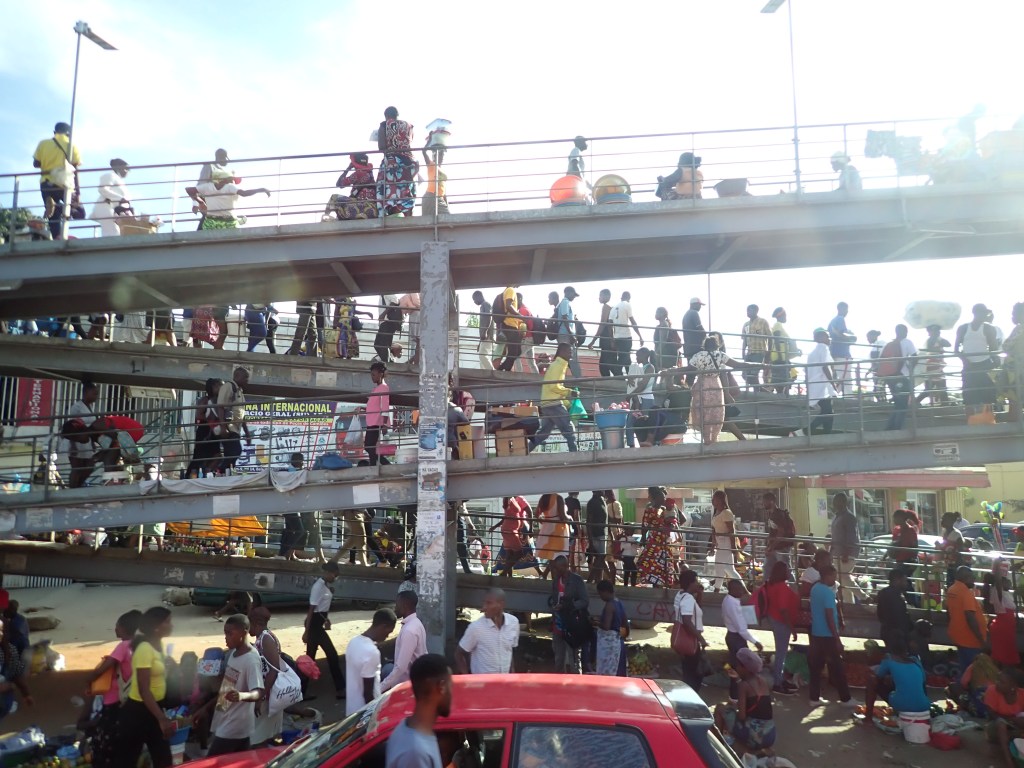
Luanda is by far the largest city in Angola. Many of the residents fled the countryside for the relative safety of the city during the protracted civil war, swelling the city’s population and straining its resources. The people have been loath to return to the rural areas. The oil reserves fueling the development of Angola do not benefit the people equally, resulting is a massive wealth gap. Toward the harbor north of the airport I could see the shining skyscrapers of the business district. Seeing that part of the city would have to wait.
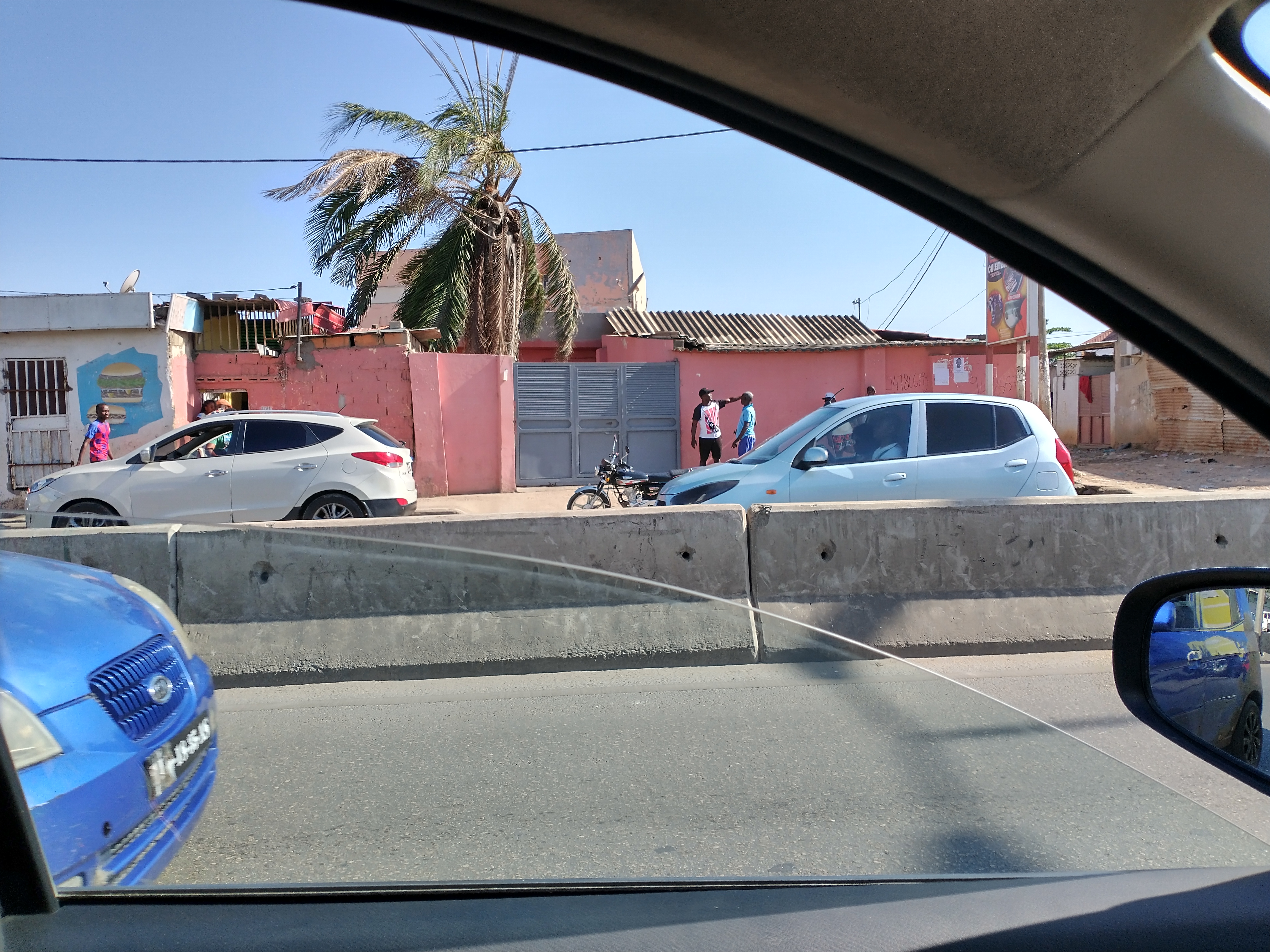
Our destination was near the airport in an area characterized by simple homes and close quarters. The roads were narrow, and the houses exited directly onto the little strip of sidewalk. We walked close to the bustling traffic in the dusty streets. Winding side alleys led to the many homes that were set far back from the road.
The houses were crowded together, as if they had been built at random and then organically grew together, forming a solid wall of concrete and sheet metal along the sidewalk. I was led to a metal gate in the wall, and after a knock and greeting, it opened from the inside. I was ushered from the dust and noise of the street into the relative quiet of a small courtyard. A single palm tree stretched into the patch of clear blue sky visible among the rooftops. We followed a passageway to the right, then left, and arrived at the front door of a home.
It was Pastor Pedro’s house. I was invited inside and offered a seat, and I gratefully accepted. As I sank down into the comfortable couch facing the front door, I was glad to finally relax after a full day of travel and the constant vigilance that goes with it. There were several hours until I needed to be at the domestic terminal to continue my travel toward Menongue. We spent some time exchanging pleasantries about our lives and families, and Mario did an admirable job interpreting for us as we all talked. The television on the wall was tuned to an English news channel, and the topic of the hour was the coronavirus and how it was marching, largely unhindered, across the globe. Wessel called Pastor Pedro to confirm that I had arrived safely and welcome me to the country.
Tour of church and school
They offered to show me their nearby church and school, so we left the house for a short walk. Traffic there doesn’t stop for pedestrians; you look for a suitable gap and then move with purpose. There were no shoulders to the road, and when we stopped in the thin strip of median, traffic whizzed close by in both directions. The four of us made it safely across the street and walked down the nearest alley. The close-set buildings rose up high on either side. Among the rubble on the path was a flattened Coca-Cola can – a familiar symbol in such unfamiliar surroundings.

The alley ended at the open wooden gates of a walled compound housing the school and church that Pastor Pedro and his group operated. As we entered the courtyard between the buildings, a small welcoming committee offered salutations. Our arrival caused a stir among the students, who were suddenly preoccupied with stealing glances at the visitor through the open schoolroom door.
They led me into the church building. A cross shape was recessed into the vaulted white ceiling. Tall stacks of plastic chairs rested against the far wall, and the baptismal, sunk into the front platform, lay uncovered. Sunlight streamed in from high-set windows, glinting off the marbleized tile and illuminating every corner of the large space. We went up to the balcony, and I walked up to an open window. Below me lay an expanse of rooftops stretching out into the city, each one strewn with odds and ends. Mario conveyed that the roof clutter holds the sheet metal down, because using fasteners is too expensive. I commented, “All of that stuff is there to hold down the roof?” to which he replied, “No. Some of it is just trash.”

We briefly visited the school children as they were studying, and Pastor Pedro held a short conference with some faculty members. All too soon, it was time to go. As we walked back to the house, my three companions walked close around me. The city seemed safe enough, but that might have been thanks to their guarding presence. After a quick meal back at the house, it was time to get back to the airport.
My airport guide
My visit had been well orchestrated by Wessel and company. I was able to rest between flights, and I got a brief tour of the local area, all with the benefit of a translator. They would now deliver me to the domestic terminal, which was separated from the international terminal by several city blocks. As a final favor to me, after saying goodbye, they handed me off to a man named Nicolo who apparently worked at the airport. He would help me navigate the boarding process. He had come running up as we arrived, quickly putting on a fluorescent safety vest and a badge.
Without delay, he ushered me to the Premier check-in line. He did most of the talking to the woman behind the counter and translated for me as best he could. In no time, my bag was checked, and I had my boarding pass in hand. Nicolo then walked me through the security screening, letting me know what to remove from my carry-on bag. We finally got to my gate, and we sat down and waited. At first, I thought he was supposed to be working while he was there, but it dawned on me that he had only showed up that day to help me.
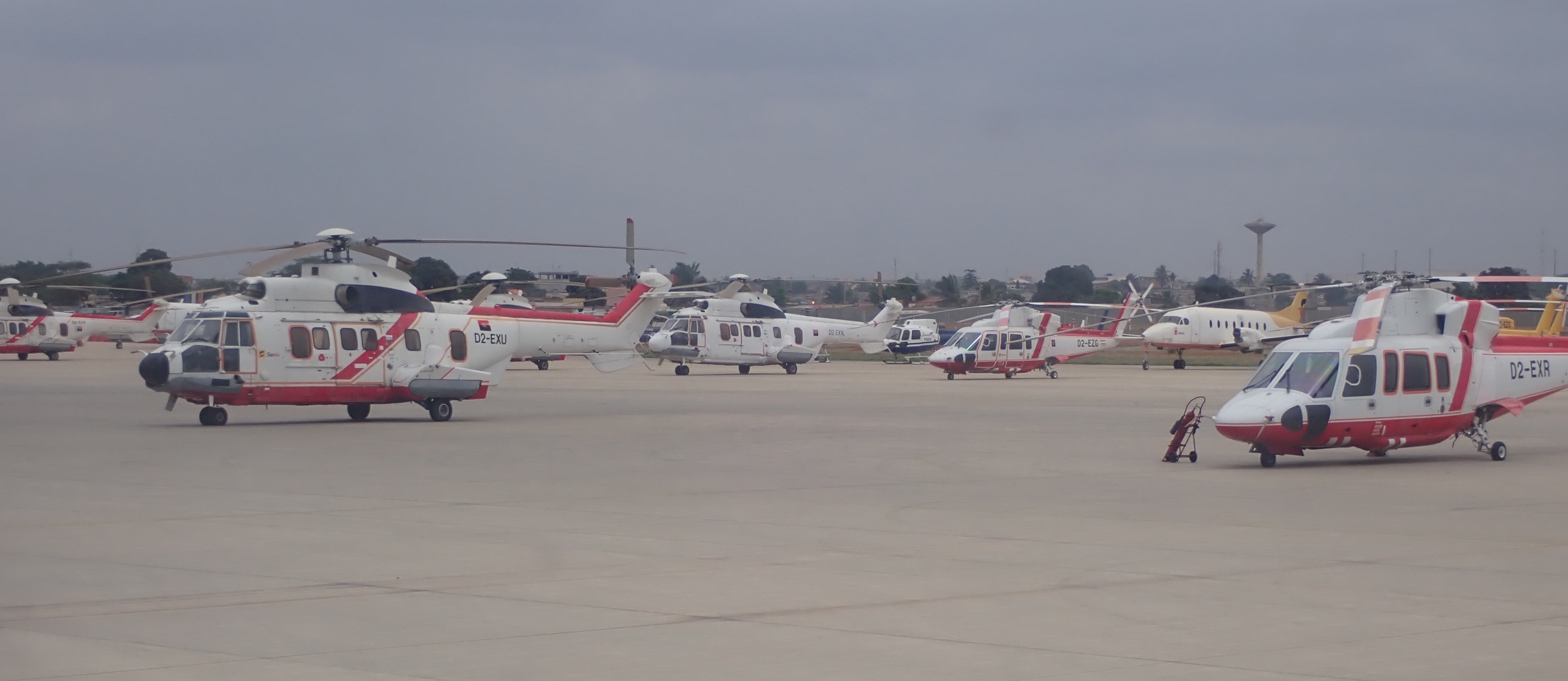
After waiting a little while, he motioned for me to follow him. We walked up to the second floor, and he showed me the fleet of helicopters sitting out on the tarmac. I gathered that they were for offshore use on the oil rigs. I would have taken pictures, but my Angola guidebook advised never to take pictures near official installations, including airports. Through Nicolo’s halting English, I learned some things about him. He had been a member of the airport police for 4 years, so I could not have asked for a better guide. He shared that a dream of his was to see California someday. I hope he does.
After two shuttles came and went, Nicolo gestured that the third one was for me. With sincere appreciation, I thanked him for his help, bid him farewell, and headed out the terminal doors and onto the shuttle. He had guided me through the entire process, staying by my side until boarding time. It would have been much more stressful without his aid. There was one little task left. Exiting the shuttle and walking toward the airplane, I saw there was a baggage cart off to the side. I noticed that other passengers were pointing at bags on the cart before boarding the plane, so I followed their example. I later learned that if I hadn’t done this step, my bag would not have been loaded onto the plane.
I boarded and settled into my seat. The preflight instructions were carried out per normal, first in Portuguese, then in broken English. I seemed to be the only person on the flight with a mask on. I had decided to keep wearing it until I reached the relative isolation of Menongue, where the threat of the coronavirus would theoretically be reduced. Then I would have no need of it until my return flight in just 8 days.

 Welcome to Angola
4 responses to “Memoir: Welcome to Luanda”
I think I’ve told you before Michael, how I love your writing style. Those little humorous parts, the ways of expressing that are just you. We are praying for you, trusting for health and anointing to do what God has sent you for, the encouragement and grace you need every day.
LikeLike
Thank you for the encouragement, Janet. It helps me stay motivated to keep posting. And thank you so much for your prayers!
LikeLike
[…] The story continues >> […]
LikeLike
[…] << Previously […]
LikeLike